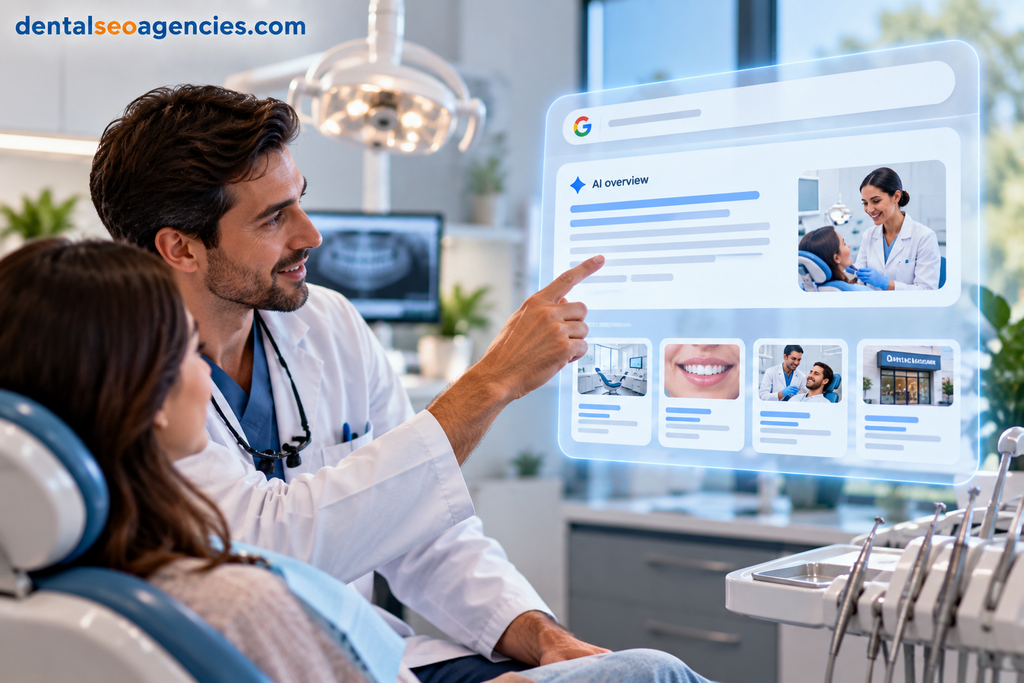
Patients rarely start with “dentist near me”. They start with a worry: a cracked tooth, the cost of implants, whether Invisalign hurts, whether insurance covers a crown. In 2026 Google answers most of those questions with an AI Overview at the top of the page, and the practices quoted inside that answer are the ones patients remember.
Getting a dental practice into AI Overviews is not a single trick. It is a combination of answering patient questions well, ranking in the normal results, proving the content comes from real dental expertise, and keeping the practice’s listings consistent across the web. This guide walks through each step, with the data behind it.
Request Dental SEO Quote
Why AI Overviews Are Important for Dentists
| Statistic | Figure | Source |
|---|---|---|
| Local business searches that show an AI Overview | 68% | Whitespark, 540 searches including dentists, 2025 |
| Informational local searches that show an AI Overview | 92% | Whitespark, 2025 |
| Local-intent searches that still show the local pack | 93% | Whitespark, 2025 |
| AI Overview citations that rank in the top 10 organic results | 76.1% | Ahrefs, 1.9 million citations |
| Click-through rate for a business recommended inside a Google AI answer | 7.3% | First Page Sage, 2026 |
| Healthcare citations in AI search that come from listings and directories | 52.6% | Yext, 6.8 million citations |
| Consumers who used AI to get a local business recommendation in the past year | 45% | BrightLocal, 2026 |
Two things stand out. First, AI Overviews mostly appear on question-style searches, not on “dentist near me”. Second, three-quarters of the pages they cite already rank on page one. Being cited is an extension of good SEO, not a replacement for it. If you want to confirm whether your practice already shows up, our guide to AI Overviews and AI Mode explains how the two Google features differ.

How Google Chooses Sources for Dental AI Overviews
- Organic ranking. Pages that already rank in the top 10 make up the large majority of citations.
- A clear, quotable answer. Google pulls short passages that answer the question directly.
- Trust signals. Dental advice is health advice, which Google treats as “Your Money or Your Life” content. Named dentists, credentials and medical review matter.
- Consistent practice information. Google cross-checks your name, address, services and hours against your Business Profile and dental directories.
- Third-party sources. For “find a dentist” questions, AI answers lean heavily on Google Business Profile, Healthgrades, Zocdoc, Yelp and similar directories. For treatment questions, they draw on sources such as WebMD, Cleveland Clinic, the ADA’s MouthHealthy site and Reddit, according to a 2026 dental AI visibility audit by 5WPR.
12 Steps to Get Your Dental Practice Into AI Overviews
1. Find the Questions Patients Actually Ask
Start with the questions your front desk hears every week. Then check Search Console for question searches that already bring impressions, and look at the People Also Ask boxes for your main treatments. Most dental AI Overviews appear on these types of searches:
| Question Type | Examples | Page to Build |
|---|---|---|
| Cost | how much does a root canal cost, dental implant cost in [city] | Treatment cost guide |
| Pain and recovery | does a tooth extraction hurt, how long does a dental implant take to heal | Treatment page with recovery section |
| Comparison | crown vs filling, Invisalign vs braces, veneers vs bonding | Comparison page |
| Insurance and payment | does insurance cover dental implants, dental financing options | Insurance and payment page |
| Emergency | what to do if a tooth gets knocked out, is a toothache an emergency | Emergency dental page |
| Children | when should a child first see a dentist, are dental X-rays safe for kids | Pediatric dentistry page |
| Eligibility | am I a candidate for implants, can you get veneers with gum disease | Treatment page with candidacy section |
2. Answer Each Question in the First Two Sentences
AI Overviews quote short, self-contained passages. Put a direct answer immediately under each question heading, then add detail. The same structure also wins featured snippets, as our featured snippet guide explains.
Weak answer
At our practice we believe every smile is unique, which is why we take time to understand your needs before recommending any treatment. Implant costs can vary for many reasons…
Strong answer
A single dental implant in [city] typically costs between $X and $Y, including the implant, abutment and crown. The final price depends on whether you need a bone graft or extraction first, and many insurance plans cover part of the crown.
The strong version names the treatment, the place, a real range and the factors that change it, all in two sentences. Use your own fee ranges; vague answers are rarely quoted.
3. Build a Dedicated Page for Each Treatment
One page that lists every service cannot answer specific questions well. Give implants, root canals, Invisalign, veneers, crowns, whitening, extractions, emergency care and pediatric dentistry their own pages, each covering what the treatment is, who it suits, the steps, recovery, cost and insurance, and common questions.
4. Rank in the Top 10 for Those Questions
Because three-quarters of cited pages already rank on page one, normal SEO comes first: a fast, mobile-friendly site, clear title tags and headings, internal links between related treatment pages, and pages that cover a topic more usefully than competing results.
5. Show Who Wrote and Reviewed the Content
Add a byline for the dentist who wrote or reviewed each clinical page, with their qualifications, years in practice, professional memberships and a link to a full bio. Add a “medically reviewed by” line and a last-reviewed date. These are exactly the trust signals Google looks for on health content.
6. Add Structured Data
Use schema markup so Google can read your practice details reliably: Dentist or LocalBusiness markup on the home and contact pages, Person markup for each dentist, and FAQPage markup on question sections. Schema does not guarantee a citation, but it removes doubt about who you are and what you offer.
7. Complete Your Google Business Profile
Choose the right primary category (such as Dentist, Cosmetic dentist or Pediatric dentist), list every service with a short description, add real photos of the team and practice, keep hours current, and post regularly. Google Business Profile is one of the sources AI answers use most for local practices. Our Google local SEO statistics show how much patient discovery still starts there.
8. Claim and Match Your Directory Profiles
For “find a dentist” questions, AI answers often cite directories ahead of practice websites. Claim and complete your profiles on Healthgrades, Zocdoc, Yelp, Vitals, WebMD’s directory and the ADA’s Find-a-Dentist, plus any specialty directories such as the American Academy of Cosmetic Dentistry or American Academy of Pediatric Dentistry. Make sure the practice name, address, phone number, dentists and services match your website exactly.
9. Earn Reviews That Mention Treatments
Reviews that say “my implant procedure was painless and Dr. Patel explained every step” do more than “great service”. Ask happy patients to mention the treatment they had, and reply to reviews in a way that names the service where appropriate. Never offer incentives for reviews.
10. Create Useful Location Pages
If you serve several neighbourhoods or towns, give each its own page with genuinely local details: parking and access, nearby landmarks, the dentists who work there, local insurance plans accepted and patient stories from that area. Pages that only swap the town name rarely get cited.
11. Get Mentioned Beyond Your Own Website
AI systems trust what others say about you. Contribute expert quotes to local news, speak at schools and community events, join local business groups, and answer dental questions where patients ask them. Our article on brand mentions vs backlinks explains why unlinked mentions now carry weight.
12. Keep Key Pages Up to Date
Review cost, insurance and treatment pages at least once a year. Update prices, technology and insurance details, and change the review date when you do. AI systems favour content that has been maintained, and outdated prices quickly erode patient trust.
Technical Checks Before You Start
| Check | Why It Matters |
|---|---|
| Googlebot can crawl and index your treatment pages | AI Overviews use Google’s normal search index |
| No nosnippet or max-snippet:0 tags on pages you want cited | These tags stop Google showing your text in snippets and AI Overviews |
| Important text is in HTML, not only in images or videos | Google needs readable text to quote |
| Pages load quickly on mobile | Most patients search on phones, and slow pages rank lower |
| One page per treatment, without near-duplicates | Duplicate pages compete with each other and dilute signals |
| Consistent practice name, address and phone across the site | Mismatches confuse Google about which details are correct |
Blocking Google-Extended in robots.txt does not remove a site from AI Overviews; it controls use of content for some of Google’s AI models, not Search features.
Common Mistakes Dental Practices Make
- Writing treatment pages as sales copy instead of answering patient questions.
- Hiding prices completely, so AI Overviews quote competitors who give ranges.
- Publishing clinical content with no named dentist or review date.
- Letting directory listings show old addresses, phone numbers or dentists who have left.
- Creating dozens of near-identical city pages.
- Relying on “dentist near me” rankings alone and ignoring question searches.
How to Track Your AI Overview Visibility
Google Search Console includes AI Overview impressions in its normal Performance report but does not separate them, so you cannot see AI Overview traffic on its own there. Keep a list of 20 to 30 patient questions for your area and check them regularly, or use one of the AI visibility tracking tools that record which practices and pages each AI answer cites. Track new-patient calls and booking requests alongside, because those are the numbers that matter to the practice.
Frequently Asked Questions
Can a Dental Practice Pay to Appear in Google AI Overviews?
No. Citations in AI Overviews are organic. Google shows ads above or below AI Overviews in some markets, but being quoted inside the answer cannot be bought.
How Long Does It Take for a Dentist to Appear in AI Overviews?
If your pages already rank on page one, improving answers and trust signals can lead to citations within weeks. Practices starting from low rankings usually need several months of SEO first.
Do AI Overviews Show for “Dentist Near Me” Searches?
Rarely. In Whitespark’s study, AI Overviews appeared on 15% of local-intent searches, while the local pack appeared on 93%. AI Overviews dominate question-style dental searches instead.
Does Schema Markup Help Dentists Appear in AI Overviews?
It helps Google understand who you are and what you offer, which supports citations, but it does not guarantee them. Clear answers and strong rankings matter more.
Which Dental Pages Are Most Likely to Be Cited?
Pages answering cost, recovery, comparison and insurance questions, such as implant costs, root canal recovery and Invisalign vs braces, written or reviewed by a named dentist.
Should Dental Practices Publish Prices?
Giving realistic price ranges with the factors that change them makes a page far more likely to be quoted for cost questions, and helps patients decide to call.
For the wider strategy behind AI search, see our introduction to generative engine optimization.
Want to put ChatGPT to work inside the practice as well? See 5 tips to grow your dental practice with ChatGPT.