The best CRM for a solo dental practice is Weave. It starts at $199 a month, and it puts reminders, two-way texts, review requests and your office phones on one screen. For a busy office that wants paperless intake with clear prices, we pick Yapi at $299 a month. For groups and DSOs, Dental Intelligence is our pick, because it pairs patient messaging with practice analytics across six practice management systems.
We researched ten tools that dental offices use to keep patients coming back. Then we opened each vendor’s own product, pricing and terms pages. We compiled what each one does, which software it syncs with and what it costs. Where a vendor only quotes prices in a demo, we say so plainly.
Request Dental SEO Quote
Our Dental CRM Picks by Practice Size
- Solo practice: Weave, from $199 a month, with phones and texting together.
- Single office going paperless: Yapi, with Core at $299 and Growth at $399 a month on annual plans.
- Office already on Curve Dental: Curve GRO, which comes inside the Curve subscription.
- Groups and DSOs: Dental Intelligence, which now includes Modento’s patient tools.
- DSO marketing teams that chase leads: HubSpot, with a BAA only for the features HubSpot approves in writing.
- Five of the ten vendors quote prices only after a demo, and Curve prices GRO inside its main plan.
What a Dental CRM Does That a Sales CRM Does Not
A dental CRM reads your practice management system every few minutes. So it knows who is booked tomorrow, who is overdue for a cleaning and who has an open treatment plan. Then it texts or emails those patients without anyone at the front desk typing a list.
A sales CRM such as HubSpot works the other way. It tracks leads, deals and email campaigns. It does not see your Dentrix schedule unless someone builds a connector. That is why most dental offices buy a patient engagement platform and call it their CRM.
In our research, the dental tools shared eight core jobs:
- Reminders and confirmations by text, email or voice, synced back to the schedule.
- Two-way texting from the office number, so patients can reply “C” to confirm or ask a question.
- Recall and reactivation for patients who are past due for hygiene.
- Review requests after each visit, mostly sent to Google.
- Online booking or booking requests from the website and Google profile.
- Digital forms for health history and consent that write back to the chart.
- Payments by text link, card terminal or patient portal.
- Reports on confirmations, no-shows and new patients.
Missed visits are the main reason practices buy these tools. Our dental no-show rate statistics cover how often patients skip, and what each empty chair costs.
Feature Comparison of 10 Dental CRM Tools
We built this table from each vendor’s own pages. “Yes” means the vendor lists the feature by name. “Ask in demo” means we could not find it on an official page, so get the answer in writing before you sign.
| Tool | Reminders | Two-way texting | Review requests | Online booking | Digital forms | Payments | PMS named by vendor | HIPAA wording | Published price |
|---|---|---|---|---|---|---|---|---|---|
| Weave | Yes | Yes | Yes | Yes | Yes | Yes | Dentrix, Dentrix Ascend | Ask in demo | From $199/mo |
| NexHealth | Yes | Yes | Yes | Yes | Yes | Yes | Ask in demo | Ask in demo | Quote only |
| Lighthouse 360 | Yes | Ask in demo | Yes | Pre-visit scheduling | Pre-visit forms | Ask in demo | Henry Schein One product | Ask in demo | Quote only |
| RevenueWell | Yes | Yes | Yes | Yes | Yes | Yes | Dentrix, Eaglesoft, Open Dental, Denticon, Eddson, Fuse | HIPAA-compliant texting | Quote only |
| Solutionreach | Yes | Yes | Yes | Yes | Yes | Yes | Ask in demo | Listed | From $329/mo |
| Adit | Yes | Yes | Yes | Yes | Yes | Yes (Adit Pay) | Ask in demo | Ask in demo | Quote only |
| Dental Intelligence | Yes | Yes | Yes (via Swell) | Yes | Yes | Yes | Dentrix, Dentrix Ascend, Eaglesoft, Open Dental, Denticon, Fuse | Ask in demo | Quote only |
| Yapi | Yes | Yes | Yes | Self-scheduling links | Yes | Ask in demo | Dentrix, Eaglesoft, Open Dental | Listed | $299 or $399/mo |
| Curve GRO | Yes | Yes | Yes | Yes | Secure links | Yes | Built into Curve | Secure links | Inside Curve plan |
| HubSpot | Workflows | Ask in demo | Ask in demo | Meetings tool | Yes | Ask in demo | None built in | BAA for approved features | Free, then $15/seat |
The PMS column matters most. A tool that does not sync with your system cannot send a reminder for an appointment it cannot see. So bring your exact software name and version to every demo.

The 10 Patient CRM Tools Dental Offices Use
We ordered these by how many practice sizes each one serves well. Each entry covers what the tool does, which software it reads and what we know about the price.
1. Weave Puts Phones and Patient Texts on One Screen
Weave is our pick for a solo office. Its dental page lists reminders, two-way texting, reviews, online scheduling, digital forms, payments and an AI receptionist for calls and texts. It also lists a starting price of $199 a month, with a “build your bundle” option on top.
The phone system is the reason small offices choose it. When a patient calls, Call Pop shows their name and next visit before the front desk picks up. So one person can answer the phone and the text inbox from the same screen.
Weave is an authorized vendor in the Henry Schein One API Exchange. Its Dentrix and Dentrix Ascend links cover reminders, save-the-date messages, schedule sync and review requests after visits. Weave also says it is the exclusive patient engagement platform for American Dental Association members.
Weave could name more practice management systems on its dental page. Offices on Eaglesoft or Open Dental should ask for the sync details in the demo.
2. Yapi Publishes Two Plans for Paperless Offices
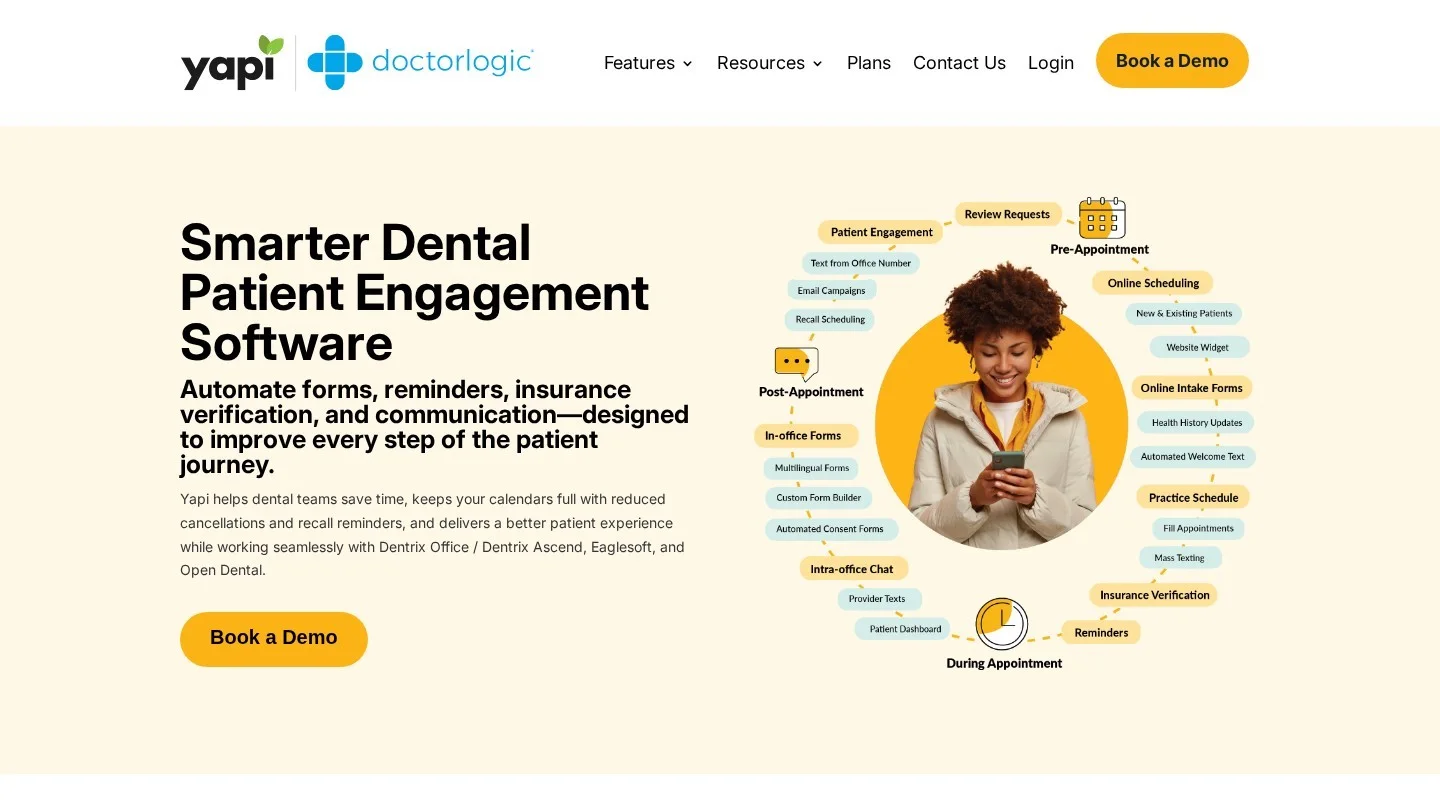
Yapi is one of the few dental tools that prints its prices. Yapi lists a Core plan at $299 a month and a Growth plan at $399 a month, both on annual terms. So a single office can budget for the year before the first call.
Yapi syncs with Dentrix, Open Dental and Eaglesoft, and it says those three are the only systems it supports. Data syncs in real time. When a patient replies to confirm, the status updates in the schedule.
Forms are its main strength. Patients fill in forms online and upload a photo of their insurance card before they arrive. Then they can book through self-scheduling links. However, Yapi limits mass texting to patients on chosen appointment dates. So an office that runs big recall blasts may want a second look at RevenueWell or Solutionreach.
3. Dental Intelligence Joins Analytics With Modento’s Patient Tools
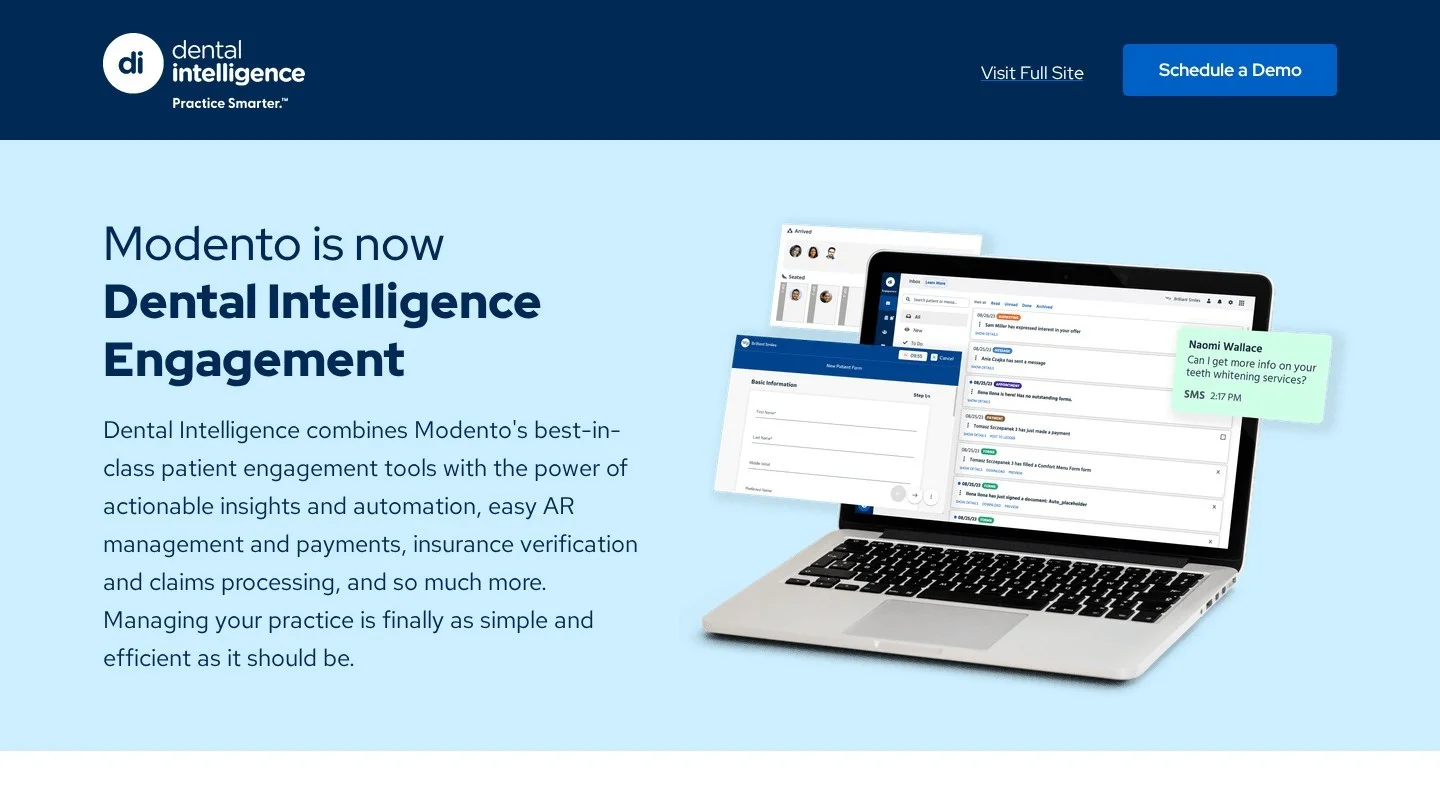
Dental Intelligence is our pick for groups and DSOs. Modento is now part of it and is sold as Dental Intelligence Engagement. So one vendor covers patient messaging and the numbers behind it.
We read its product terms in full. Engagement covers online scheduling, reminders, automated recalls and two-way messages. It also covers digital forms, kiosk check-in, email campaigns, reviews, team chat, screen pops and a loyalty program. Analytics adds the Morning Huddle, scorecards and Patient Finder, which lists patients with unscheduled treatment.
Add-ons go further. The AI Receptionist answers calls, books visits and comes with 1,000 phone minutes. Insurance checks run through a partnership with Vyne, and reviews run through a partner called Swell. Supported systems are Eaglesoft, Dentrix, Dentrix Ascend, Denticon, Fuse and Open Dental, including Open Dental Clinics.
Dental Intelligence quotes prices in a demo. Its signup form asks for location count in three bands: 1 to 2, 3 to 10 and 11 or more. Expect the quote to scale with that number.
4. NexHealth Builds Around Online Booking
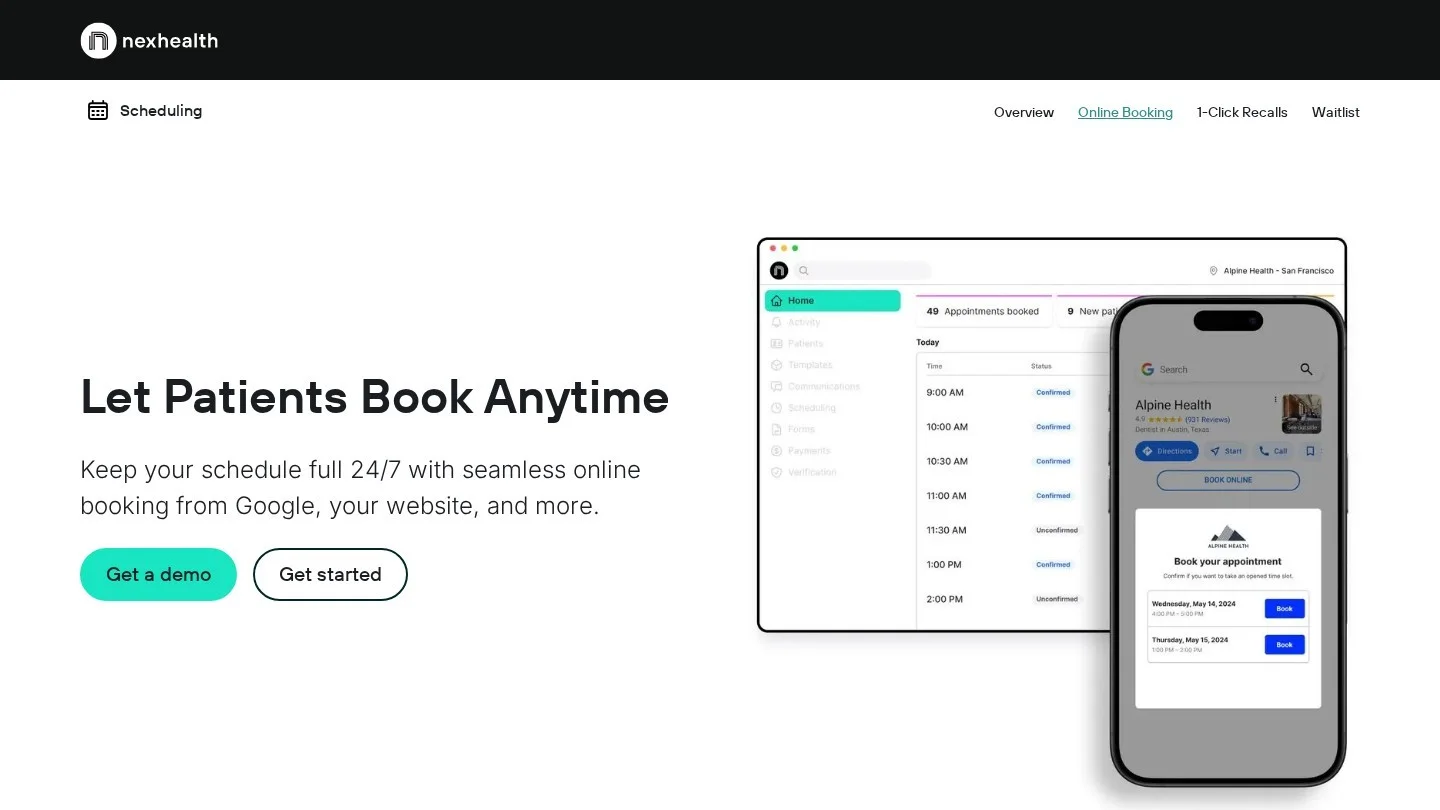
NexHealth is the tool we would look at first if online booking is the goal. Its site has separate feature pages for online booking, automated reminders, forms, payments, messaging and reviews. Booking slots come from the live schedule, so patients pick real open times.
NexHealth also sells API access to software developers. That matters for DSOs that want to connect booking to their own website or call center. In fact, its developer section has its own pricing area.
Prices come through a quote form. Its Capterra listing shows a Basic plan from $350 per feature per month. Ask NexHealth to confirm that number for your office, and ask which features are bundled.
5. Lighthouse 360 Comes From the Company Behind Dentrix
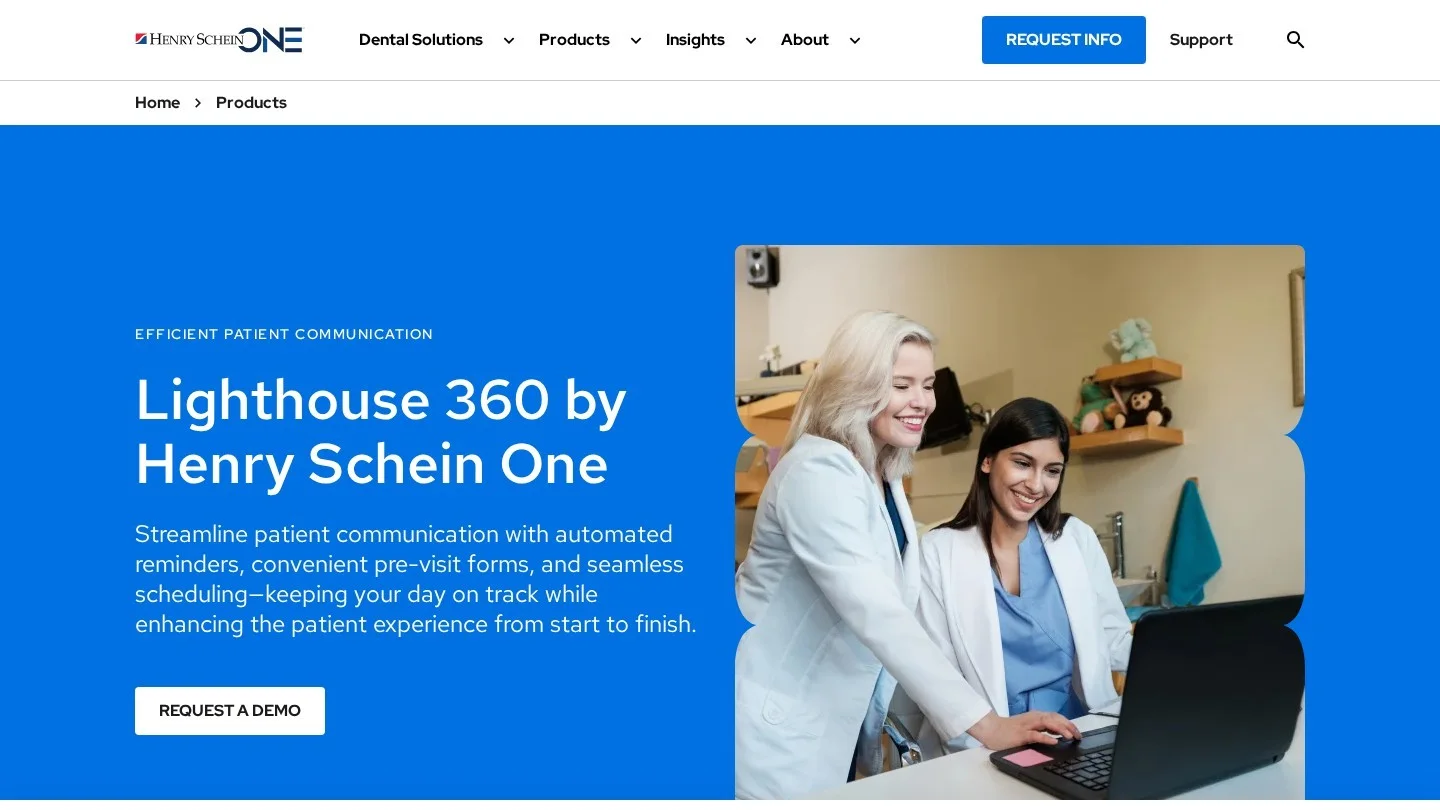
Lighthouse 360 is sold by Henry Schein One, which also makes Dentrix. It sends reminders and confirmations by text, email and phone. It also sends review requests after visits, recall reminders and pre-visit forms.
The product works in the US, Canada and the UK. Henry Schein One says it serves single offices, group practices and DSOs. It also says its clients saw a 40% average drop in no-shows, and 96% of clients saw fewer no-shows.
Pricing comes through a demo or the “Explore Options” tool. Henry Schein One could list its supported systems on the product page, because many buyers will assume it only works with Dentrix.
6. RevenueWell Adds Newsletters and Direct Mail

RevenueWell is the most marketing-minded tool on this list. Besides reminders, texting and reviews, it sends monthly newsletters, postcards and treatment plan follow-ups. It also offers more than 100 prebuilt campaign templates.
It shows six systems on its software page: Eaglesoft, Dentrix, Eddson, Open Dental, Denticon and Fuse. Its two-way texting supports images and has no character limit, and RevenueWell calls it HIPAA compliant. It also links to CareCredit for patient financing.
RevenueWell says the average practice grows production by $73,600 in year one. That is its own claim, so ask how it was measured. Prices come in a demo, and the demo offer lists no setup fees and no contract.
7. Solutionreach Lists a Flat Monthly Rate

Solutionreach is one of the oldest names in patient texting. Its Software Advice listing shows a flat rate from $329 a month. That covers reminders, two-way and mass texting, review requests, online booking, intake forms, payment reminders and newsletters.
It also serves medical and vision offices, so its tools are broad. For example, it runs patient surveys and a self-service portal. A dental office should still ask how deep the sync goes with its own system. One reviewer noted that intake forms write into Eaglesoft but not into a vision system.
8. Adit Bundles Phones, Pay and Analytics
Adit sells modules for reminders, reviews, online scheduling, digital forms and texting. Then it adds Adit Pay for payments, Adit Voice for phones and Practice Analytics. So an office can replace three or four vendors with one.
Its pricing page asks you to book a demo for prices. Adit says its tech packages carry no binding contracts. However, some offers tie into a one-year marketing commitment, so read the order form line by line.
Adit could publish its list of supported systems. Its demo form names more than 20, including Dentrix, Eaglesoft and Open Dental, but a dropdown option does not confirm a live sync.
9. Curve GRO Ships Inside Curve’s Cloud Software
Curve GRO is built into Curve Dental’s cloud practice software. Curve says it is not a separate add-on to Curve Hero or SuperHero. So an office on Curve already has a CRM to switch on.
GRO sends reminders and recare messages by text or email. Staff can text from the office number and share images. Patients self-schedule into the live calendar, view statements and pay by card. Also, review campaigns ask happy patients to post on Google, Facebook or Yelp.
Curve says offices can see up to 25% fewer no-shows. Because the CRM and the chart share one database, there is no sync lag to worry about. Offices on other systems cannot use GRO alone, though.
10. HubSpot Handles Leads for DSO Marketing Teams
HubSpot is a general CRM, and it is the only one here with a free tier. Its free tools cover up to two users. Sales Hub Starter costs $15 per seat a month, or $9 on annual billing. Professional costs $100 a month, or $90 annually, with a $1,500 onboarding fee.
DSOs use it for the marketing side: ad leads, call center follow-up and email campaigns for implants or aligners. But it has no dental schedule sync of its own. So it sits next to a patient tool, and it does not replace one.
HIPAA needs care here. HubSpot’s sensitive data terms include a Business Associate Agreement. Still, it covers only services HubSpot approves in writing and features marked as Sensitive Data Covered Services. So keep health details out of HubSpot until your order form says otherwise.
Published Prices and a Year of Fees
Only four of the ten tools show a price you can plan around. We multiplied each one by 12 months in Python. For HubSpot, we used three seats, which is a small DSO marketing team.
| Tool and plan | Published price | Year one |
|---|---|---|
| Weave, starting bundle | From $199 a month | From $2,388 |
| Yapi Core | $299 a month, annual plan | $3,588 |
| Solutionreach | From $329 a month | From $3,948 |
| Yapi Growth | $399 a month, annual plan | $4,788 |
| HubSpot Sales Hub Starter, 3 seats | $9 per seat, annual billing | $324 |
| HubSpot Sales Hub Professional, 3 seats | $90 per seat, annual billing, plus $1,500 onboarding | $4,740 |
NexHealth, Lighthouse 360, RevenueWell, Adit and Dental Intelligence quote in a demo. Curve GRO comes inside a Curve plan. So get two or three quotes before you compare them with the table.
Next, run a break-even check with your own fee. Say one kept hygiene visit is worth $150 to your office. That is a sample number, so swap in yours. Then Weave’s $199 pays for itself after 1.3 saved visits a month. Yapi Core needs 2, and Yapi Growth needs about 2.7.
Most offices with a few no-shows a week clear that bar. If you want to run the same math on marketing spend, our dental SEO ROI calculator guide uses the same method.
HIPAA Questions to Ask Every CRM Vendor
A CRM that stores appointment details or health history handles protected health information. Under HIPAA, that makes the vendor a business associate. So the practice needs a signed Business Associate Agreement before any patient data flows.
We noticed that few dental vendors put the BAA on a public page. RevenueWell, Solutionreach, Yapi and Curve use HIPAA wording on their pages, and HubSpot publishes its BAA terms. For the rest, ask these questions in the demo:
- Will you sign our BAA, or send yours before the contract?
- Which features does the BAA cover, and which ones does it leave out?
- Where are texts, forms and call recordings stored, and for how long?
- Can staff logins have roles, so a hygienist cannot export the patient list?
- What happens to our data if we cancel?
Review replies carry risk too. A reply should never confirm that the reviewer is a patient or mention their treatment. Our guide to getting more five-star dental reviews has safe reply wording. Also, the same care applies to AI tools, which our guide on using ChatGPT in a dental practice covers.
Review Requests Without Breaking Google’s Rules
Every tool on this list can text a review link after a visit. But Google bans selectively asking only happy patients for reviews. So set the request to go to every patient after a completed visit, and do not filter by a survey score first.
Some tools send a short survey first and only pass high scores to Google. Turn that setting off if your tool has it. Also, send the text on the same day, while the visit is fresh. Our dental Google reviews statistics show why the count and recency of reviews matter to patients.
Reviews also feed your map ranking. For instance, our guide to the Google local 3-pack for dental clinics explains how reviews and replies work with the rest of your profile.

Run a Demo With Your Own Schedule Data
Sales demos use clean sample data. Yours is messier. So book every demo with a list of real cases from last month, with names removed.
- Family booking. Ask them to send one reminder for a parent and two kids booked back to back.
- Confirm and write back. Have them show a “C” reply turning the appointment to confirmed in your system.
- Overdue recall. Ask for a list of patients past due for hygiene by six months or more.
- Open treatment. Ask how the tool finds patients with an unscheduled crown or implant plan.
- Online booking rules. Ask whether you can block new patients from booking a 15-minute slot meant for an emergency.
- Forms write-back. Watch a health history form land in the chart as data, and not only as a PDF.
Then ask about the contract. Get the term length, setup fee, text limits and cancellation notice in writing. Also ask whether your number and message history move with you if you leave.
Booking links should also show on your website and Google profile. Some sites need a rebuild to hold a booking widget. In that case, our list of dental website design services in the USA is a good next read.
Matching a CRM to Your Number of Offices
We grouped our picks by setup. Find your row, then book demos with the first two names.
| Your practice | First pick | Second look | Why |
|---|---|---|---|
| Solo dentist, one office | Weave | Yapi | Lowest published start price and phones in the same tool |
| One busy office going paperless | Yapi | NexHealth | Forms, insurance card upload and clear annual prices |
| Office on Curve Dental | Curve GRO | Weave | Already inside the subscription |
| Office that wants online booking first | NexHealth | Dental Intelligence | Live-slot booking and an API for custom sites |
| Office on Dentrix that wants one vendor | Lighthouse 360 | Weave | Same company as Dentrix |
| Office that runs newsletters and mail | RevenueWell | Solutionreach | 100+ campaign templates and postcards |
| Office replacing phones, pay and texts | Adit | Weave | Phones, payments and analytics in one bundle |
| Group of 3 to 10 offices | Dental Intelligence | NexHealth | Analytics and messaging across six PMS |
| DSO with a marketing team | Dental Intelligence plus HubSpot | Weave plus HubSpot | Patient tool for care, HubSpot for leads |
Groups have extra work, such as one brand with many Google profiles. Our guide to multi-location dental SEO covers that side.
Dentists’ Questions About Patient CRM Software
Is a Patient Engagement Platform the Same as a Dental CRM?
For most dental offices, yes. Tools like Weave, Yapi and RevenueWell do the CRM jobs that matter in a practice: reminders, recall, texting and reviews. A sales CRM like HubSpot only becomes useful when you run paid campaigns with a team that follows up on leads.
Does Dentrix or Open Dental Have a CRM Built In?
Both store patient records and recall dates. However, most offices add a separate tool for texting, reviews and online booking. Curve Dental is the exception on our list, because GRO comes built into its software.
Can We Text Appointment Reminders Under HIPAA?
Yes, with a vendor that signs a BAA. Keep reminders short: the date, time and office name. Leave out the procedure, because a family member may see the phone.
How Long Does a Switch Between CRM Tools Take?
Plan for a few weeks, because the new tool must sync with your system, load your templates and move your texting number. Run both tools for a short overlap. Then turn off the old reminders, so no patient gets two texts for one visit.
Will a CRM Bring In New Patients on Its Own?
Mostly it keeps the patients you have. New patients still come from search, maps and referrals. That is why many offices pair a CRM with local SEO, and you can compare specialists on Dental SEO Agencies.