
Dental SEO ROI is the profit from new patients that organic search brought in, minus the SEO cost. Then you divide that by the SEO cost. Use profit after clinical costs, because collections alone make every program look great. In our worked example, a $2,500-a-month program loses 19% in year one on first-year value. Yet the same program returns 59% when we count five years of patient value.
We built that example in Python with labelled assumptions, so you can swap in your own numbers. Then we added the call tracking setup that feeds it and the HIPAA limits that come with that setup.
Request Dental SEO Quote
Remember These Rules When You Measure SEO Returns
- Divide profit by cost. Collections divided by cost overstated our example’s year-one return by about five times.
- Count only new patients from non-branded organic search, Google Maps and AI answers.
- Value each patient over several years, because hygiene visits keep coming after the first exam.
- Expect a loss in the first months. Google’s own hiring advice puts the usual SEO wait at four months to a year.
- Sign a business associate agreement with any call tracking vendor that records calls, and keep patient data out of Google Analytics.
Write the Dental SEO ROI Formula on One Page
Put the formula where the whole team can see it. Then agree on what goes into each part before the first report.
SEO ROI = (new patients from SEO x value per patient - SEO cost) / SEO cost

value per patient = collections over the years you count x contribution margin
Each term needs a clear rule. For example, “SEO cost” should include the agency fee, any content or photo costs and the hours your team spends. Likewise, “new patients from SEO” should count only patients who booked. Calls and clicks come earlier, so they go in a separate line.
| Term | What it means in a dental office | Where the number lives |
|---|---|---|
| New patients from SEO | First-time patients whose first contact came from organic search, Maps or an AI answer | Call tracking, GA4 key events and the intake form |
| Collections per patient | Money actually received, after insurance write-offs | Practice management system reports |
| Contribution margin | Share of collections left after supplies, lab fees and clinical wages | Your accountant’s profit and loss by category |
| Years counted | How long you expect an average new patient to stay | Recall and reactivation history in your software |
| SEO cost | Agency fee plus content, photos and staff time | Invoices and payroll |

Count Every New Patient That Organic Search Sent
The patient count is the hardest number to get right. So build it from three sources and compare them each month.
Tag Calls by Source With Call Tracking
Most new dental patients still call. For that reason, give organic visitors their own tracking number on the website, and give your Google Business Profile its own number too. Then have the front desk mark each call as a new patient booked, a new patient not booked, an existing patient or spam.
Your Business Profile has its own data as well. Its Performance report counts calls, which Google defines as taps on the call button. It also lists website clicks, direction requests and the search terms people used. Those terms refresh at the start of each month.
Mark Bookings and Forms as GA4 Key Events
Next, set up GA4 so it counts the actions that lead to a booking. Mark online booking completions, form submissions and click-to-call taps as key events. After that, add UTM tags to the website link on your Business Profile. Every tag needs utm_source, utm_medium and utm_campaign, and the values are case sensitive, so type them in lowercase.
Without those tags, GA4 lumps Maps visits in with ordinary organic search. With them, you can split Maps from the rest of organic. That split matters for ROI, because many agencies bill for map work and website work as separate lines.
Ask Every New Patient How They Found You
Add one required question to the intake form. Ask how the patient first heard about the practice. Then offer short choices, such as Google search, Google Maps, an AI assistant, a friend or an insurance directory. Then record the answer in the practice management system.
The answer is not perfect. For instance, a patient who searched your name after a friend’s tip may still pick Google as the answer. Even so, comparing the form with call tracking shows you where the numbers disagree.
Remove Branded Searches From the SEO Count
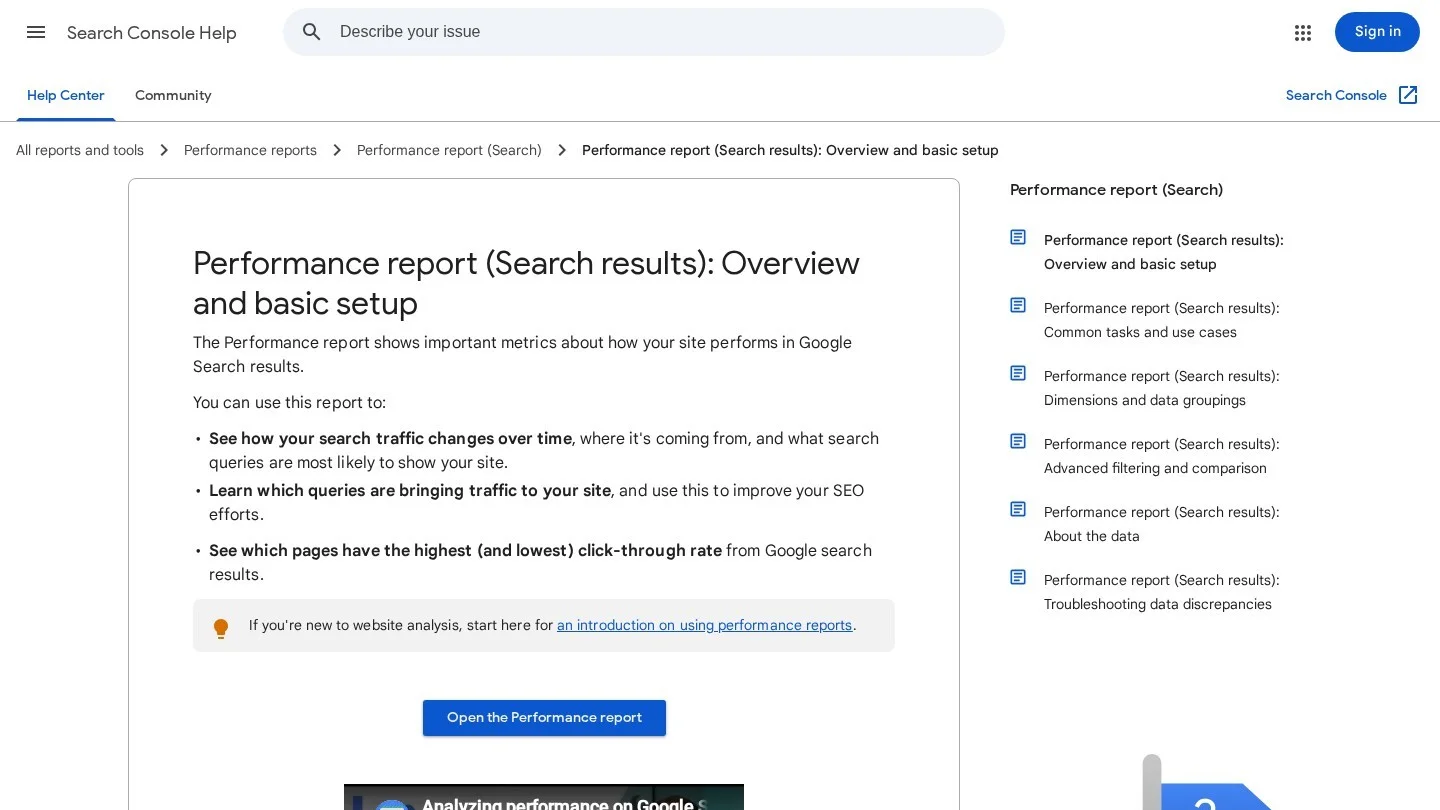
A patient who types your practice name would likely have found you anyway. So subtract branded searches before you credit SEO. In Search Console, filter the Queries report to exclude your practice and dentist names, and track non-branded clicks on their own.
Apply the same rule to calls. If the caller says they searched your name, log them under “brand,” not “organic.”
Keep Call Tracking and Analytics Inside HIPAA
A recorded call where a patient gives a name and a reason for the visit holds protected health information. So the vendor that records it is handling PHI for your practice. HHS defines a business associate as a person or company that creates, receives, maintains or transmits PHI for a covered entity. In that case, HIPAA requires a business associate agreement before the vendor handles the data.
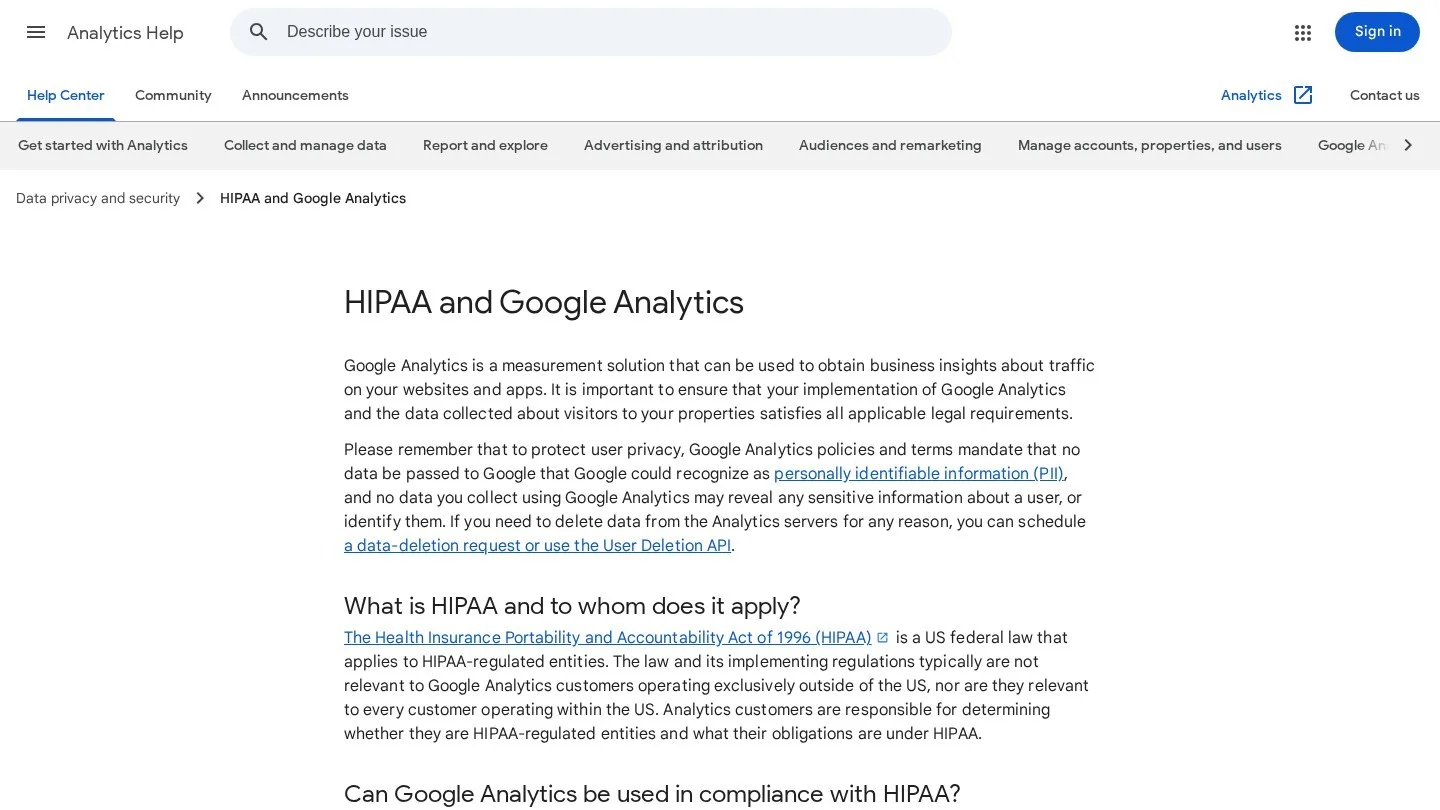
Google Analytics is a different case. Google states that it “does not offer Business Associate Agreements” for Analytics. It also says HIPAA-regulated customers must not expose PHI to Google. Authenticated pages, such as patient portals, should carry no Analytics tags at all.
HHS also published a bulletin on online tracking technologies. In June 2024, a federal court in Texas vacated part of it in American Hospital Association v. Becerra. The vacated part covered IP addresses on unauthenticated public pages. However, the rest still applies, including these points:
- A tracking vendor that handles PHI is a business associate and needs a BAA.
- A cookie banner is not a valid HIPAA authorization.
- A vendor’s promise to strip PHI after it receives the data is not enough.
In practice, keep these rules. First, never send names, phone numbers or treatment details into GA4 events. Second, keep ad pixels off booking confirmation pages and portals. Third, sign a BAA with any call tracking, form or scheduling vendor that touches PHI. Finally, check your state’s rules on recording calls, and play a recording notice if they call for one.
Work Out Patient Lifetime Value From Your Own Ledger
Patient lifetime value is the money a new patient brings in over the years they stay. For SEO math, use the profit part of it. As a result, you need five numbers, and all of them live in your own records.
| Input | How to pull it | Our example value |
|---|---|---|
| First-year collections per new patient | Total collections from patients who joined last year, divided by their count | $1,100 |
| Collections per retained patient in later years | Average yearly collections from patients in their second year or later | $600 |
| Retention rate | Share of patients seen in one year who come back the next | 70% |
| Contribution margin | Collections minus supplies, lab and clinical wages, divided by collections | 40% |
| Years counted | How far ahead the practice wants to look | 5 |
Our example values are assumptions we picked to show the math. A cosmetic or implant practice will have a much higher first-year number. On the other hand, a practice that takes many lower-fee insurance plans will have a lower one.
Your fee schedule and payer mix set the first two inputs. For instance, Aspen Dental publishes per-tooth price ranges for porcelain and composite veneers. A practice like that can model a veneer case directly.
Bupa Dental Care in Guildford takes a similar approach. Its treatment prices page puts NHS and private fees in separate columns. So a UK practice can split its value per patient by payment type.
Smile Dentist in London also goes one step further. Its implants versus bridges page shows the practice’s own fees inside the comparison table. Pages like that tell you which treatment a ranking page can sell.

Payer mix matters as much as fees. For example, Midwest Dental lists the insurance carriers it accepts on its new patient page. A practice in many networks should value patients by plan, because each plan pays a different fee for the same visit.
Run the Worked Example in Python
We wrote the model so each assumption sits on its own line. Then we ran it for two years of monthly new-patient counts. The counts start at zero, because new pages and profile changes take months to rank.
MONTHLY_FEE = 2500     # Assumption A: agency fee per month
FIRST_YEAR = 1100      # Assumption B: first-year collections per new patient
LATER_YEAR = 600       # Assumption C: collections per retained patient, later years
RETENTION = 0.70       # Assumption D: share who return each year
MARGIN = 0.40          # Assumption E: contribution margin
YEARS = 5              # Assumption F: years of value counted
RAMP = [0, 0, 1, 2, 3, 4, 5, 6, 7, 8, 9, 10] + [10] * 12   # Assumption G: new patients per month

def lifetime_collections():
    total, stay = FIRST_YEAR, 1.0
    for _ in range(YEARS - 1):
        stay *= RETENTION
        total += LATER_YEAR * stay
    return total

ltv = lifetime_collections() * MARGIN      # five-year contribution per patient
first_year = FIRST_YEAR * MARGIN           # first-year contribution per patient

for label, months in (("Year 1", RAMP[:12]), ("Year 2", RAMP[12:])):
    patients, cost = sum(months), MONTHLY_FEE * len(months)
    print(label, patients, "patients")
    print("  ROI, first-year value:", round((patients * first_year - cost) / cost * 100, 1), "%")
    print("  ROI, five-year value:", round((patients * ltv - cost) / cost * 100, 1), "%")
The model gives each new patient $2,163.86 in five-year collections. At a 40% margin, that is $865.54 of contribution per patient. First-year contribution alone is $440.
| Result | Year 1 | Year 2 |
|---|---|---|
| New patients from SEO | 55 | 120 |
| SEO cost | $30,000 | $30,000 |
| Cost per new patient | $545.45 | $250.00 |
| Contribution on first-year value | $24,200 | $52,800 |
| ROI on first-year value | -19.3% | 76.0% |
| Contribution on five-year value | $47,605 | $103,865 |
| ROI on five-year value | 58.7% | 246.2% |
So year one looks like a loss on first-year value. Then year two covers the cost of the first two years. On five-year value, the program covers its cumulative cost in month 9. On first-year value alone, it takes until month 16.
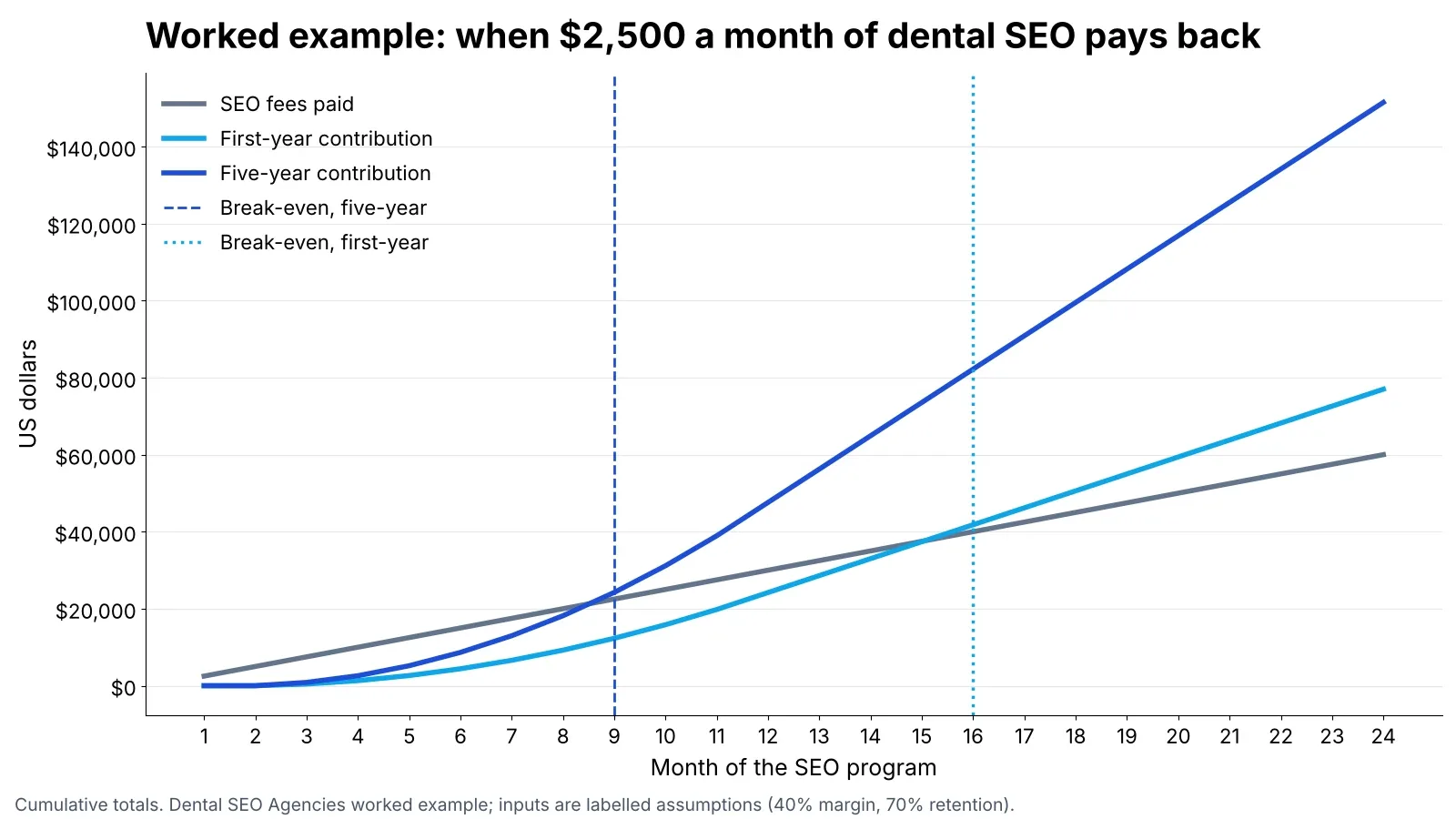
The monthly break-even point is a handy check too. At $865.54 per patient, $2,500 a month needs 2.89 new patients a month on five-year value. On first-year value, it needs 5.68.
Fill In the Calculator Table With Your Own Numbers
Copy this table into a spreadsheet. Then replace the example column with your practice’s numbers and keep the formulas in the last column.
| Line | Example | Formula |
|---|---|---|
| A. Monthly SEO cost | $2,500 | Agency fee plus content and staff time |
| B. New patients from non-branded SEO this year | 55 | Call tracking, GA4 and intake form, after removing brand |
| C. First-year collections per new patient | $1,100 | From your practice software |
| D. Later-year collections per retained patient | $600 | From your practice software |
| E. Retention rate | 70% | Patients who return the next year |
| F. Contribution margin | 40% | From your profit and loss |
| G. Five-year collections per patient | $2,163.86 | C + D x E + D x E² + D x E³ + D x E⁴ |
| H. Five-year contribution per patient | $865.54 | G x F |
| I. Annual SEO cost | $30,000 | A x 12 |
| J. ROI on five-year value | 58.7% | (B x H – I) / I |
| K. ROI on first-year value | -19.3% | (B x C x F – I) / I |
| L. Break-even new patients per month | 2.89 | A / H |
| M. Cost per new patient | $545.45 | I / B |
Line L is the one to watch in the early months. If organic search sends fewer than that many new patients a month after the first year, ask your agency why.
Read the Result Against the Right Time Frame
A negative first-year ROI does not mean SEO failed. Google’s own advice on hiring an SEO says most need four months to a year to make changes and then see a benefit. Because of that, judge year one on early signs, such as more non-branded clicks, more Maps calls and better positions for treatment pages. Our dentist SEO guide covers the work that moves those signs.
Then judge year two on patients and profit. In our example, cost per new patient fell to $250.00, down from $545.45, because the fee stayed flat while bookings grew. Paid ads work the other way, since each click costs money. For the full picture, our comparison of Google Ads and dental SEO runs the numbers on that trade.
Also, compare the result with what you can still control. For example, a missed call is a lost patient whatever brought it in. So if call tracking shows many unanswered new-patient calls, fix the phones before you blame the SEO.
Spot ROI Reports That Overstate the Return
The most common error is using collections in place of profit. In our example, dividing five-year collections by cost gives a year-one ROI of 296.7%. Yet the real return on five-year contribution is 58.7%. That is five times too high.
Also watch for these other inflators in agency reports.
- Counting all organic traffic, including people who searched your practice name.
- Valuing traffic at what the same clicks would cost in Google Ads.
- Counting calls from existing patients as new patients.
- Counting every call as a booking, including spam and wrong numbers.
- Valuing each patient at a full implant case when most new patients come in for a checkup.
A fair report shows new patients from non-branded search, the value per patient and the method. Then you can check the math yourself. Our guide on why dental SEO takes time lists the early signs to expect before patients show up.
Split ROI by Office When You Run a Dental Group
A group should run the same math for each office, because each one ranks on its own. So give every location page its own tracking number and its own UTM-tagged Business Profile link.
Gentle Dental’s Brookline office page shows the setup that makes this possible. It has the office’s own address, hours, map, dentists and treatments. As a result, calls and form fills from that page belong to one office.
Then split the agency fee by office too. For instance, a $10,000 monthly retainer across eight offices is $1,250 per office, which sets a lower break-even point per location. Our guide to multi-location dental SEO covers location pages and tracking for groups.
Answer What Practice Owners Ask About SEO Returns
What Is a Good ROI for Dental SEO?
There is no single target, because margins and fees vary by practice. A program should at least cover its cost on the patient value you chose to count. In our example, that happened in month 9 on five-year value.
How Long Before Dental SEO Shows a Positive ROI?
Expect several months. In fact, Google’s own advice puts the usual SEO wait at four months to a year. Map pack gains for an existing office can come faster than new treatment pages, as our guide to the local 3-pack explains.
Should We Count Referrals From SEO Patients?
You can, but keep them in a separate line. A new patient who refers a friend adds value, yet the referral is hard to trace. So report ROI without referrals first, and show referrals as an extra.
Can We Track AI Search Patients the Same Way?
Yes. First, add “AI assistant” to the intake question. Then watch the AI referral traffic in GA4. Our guide to AI SEO for dentists explains how practices show up in those answers.
Is Call Recording Allowed Under HIPAA?
HIPAA does not ban it. However, a recording that holds patient details is PHI, so the vendor needs a BAA and the files need protection. State laws on consent to record calls also apply.
Produce a Monthly ROI Report Within 30 Days
First, in week one, add the intake question and turn on call tracking with a signed BAA. In week two, add UTM tags to every Business Profile link, and mark bookings, forms and call taps as key events in GA4.
Next, pull last year’s collections, retention and margin from your software and your accountant. Then fill in the calculator table. After that, run the report on the same day each month, and keep branded and non-branded numbers apart. If you plan to research new treatment pages first, our list of dental keyword research tools is the next step.