
Treatment comparison pages, such as “implant vs bridge,” are worth the risk on a dental website. The condition is that each page is fair, checked by a dentist and built from facts with a source. A patient weighing two treatments is close to booking, so these pages can bring in high-value consults. However, they also sit in Google’s most careful category of content, and some states regulate how dentists advertise treatments. So the risks are real: thin copy-paste pages, claims nobody can verify, and wording a dental board could object to.
We studied three practice comparison pages, in California, Maryland and Massachusetts. Then we checked them against Google’s guidance on people-first content and the ADA’s patient pages on implants and bridges. We also read California’s dental advertising rules in the state code. If you need the keyword list first, start from our dental treatment comparison keywords guide.
Request Dental SEO Quote
Hold On to These Comparison Page Facts
- Google says trust is the most important part of E-E-A-T, and health topics get extra weight as “Your Money or Your Life” topics.
- The ADA describes a fixed bridge as attached to surrounding teeth, and says only a dentist can remove it.
- The ADA notes some patients choose implants because they do not want healthy tooth structure removed for a bridge.
- California’s dental code treats advertising that guarantees a dental service, or promises a painless procedure, as unprofessional conduct.
- KYT Dental Services in Fountain Valley labels its implant and bridge prices as typical Orange County costs.
Weigh the SEO Upside of a Versus Page
A patient who searches “implant or bridge for one missing tooth” already knows they need treatment. They are choosing how. That puts a comparison page late in the decision, next to cost and booking pages. Our dental content funnel guide shows where these pages sit next to symptom articles and service pages.
Comparison pages also help patients who arrive on the wrong treatment page. Someone reading your bridge page may wonder about implants. So a link from each treatment page to its matching comparison keeps that visitor on your site. Also, a good comparison answers the questions your front desk hears on the phone, which saves staff time.
Still, build only the pairs your patients really weigh. Implants against bridges, aligners against braces, and root canal against extraction are common pairs in general practice. A page on two treatments you do not offer will not book anyone.
Learn From Three Practice Pages Comparing Implants and Bridges
Each of these practices takes a different approach to the same pair. Together, they show what a working comparison page includes.
Put Local Prices in an Eight-Row Table, Like KYT Dental Services
KYT Dental Services in Fountain Valley, California, uses a head-to-head table with eight rows. The rows cover what each option does, the effect on neighboring teeth and bone preservation. Others cover typical cost, timeline, longevity, PPO coverage and what happens if a problem develops. The practice lists an implant at $3,000 to $6,000 including the crown, and a three-unit bridge at $2,500 to $5,500. Both are labeled as typical Orange County costs.
Then a “Common questions” section answers six more, including if a bridge can become an implant later. Several booking buttons and a phone number close the page. That local cost label is the detail to copy, because it tells the reader where the numbers come from.

Give Each Option Its Own Table, Like Gentle Dental
Gentle Dental runs 49 locations across Massachusetts and New Hampshire. Its bridge-or-implant article walks through how each works, the procedure, pros and cons, and the deciding factors. Next, it gives each option a table covering durability, appearance, cost, procedure length, bone health and complications. It also covers alternatives and aftercare before a five-question FAQ.
The article gives cost ranges too. It puts bridges at $1,500 to $5,000 on average and a single-tooth implant at $3,000 to $6,000. Because the article serves all 49 offices, one page covers the whole group. That avoids 49 near-copies of the same comparison.
Sign the Page With a Dentist’s Name, Like Rockville Dental Arts
Rockville Dental Arts in Rockville, Maryland, puts an author credit on its page: Dennis Norkiewicz, DDS. It sets out pros and cons for both options. Then it adds a five-row table on bone preservation, effect on nearby teeth, surgery, durability and independence. It then gives cost ranges and closes with a phone number and a consult link.
The named dentist matters for Google’s “Who” question, which we cover next. Also, the page ends by saying the right choice depends on a clinical exam of bone health, nearby teeth and the patient’s priorities. That line keeps the comparison from reading like a promise.


Run Every Draft Through Google’s People-First Questions
Google’s guide to helpful, reliable, people-first content works as a review checklist for comparison pages. It asks if the content is written or reviewed by an expert who knows the topic well. It also asks if the page has easily verified factual errors. On a page about two treatments, one wrong fact can break the whole comparison.
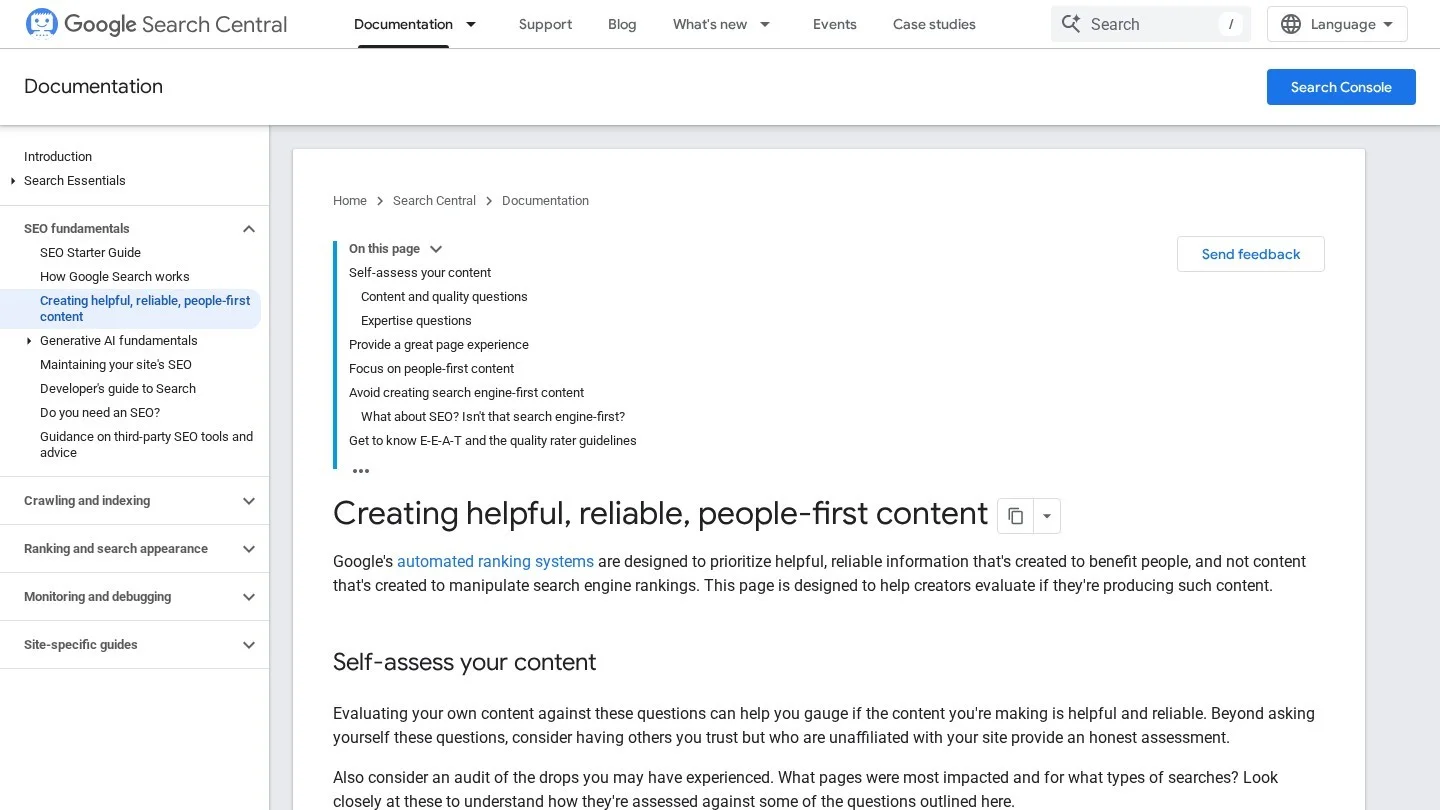
The same guide says trust is the most important part of E-E-A-T. Next, it explains that topics affecting health, finances, safety or well-being get extra weight. Google calls these “Your Money or Your Life” topics. Every dental treatment page falls in that group, and comparison pages more so, because they steer a decision. Our dental website E-E-A-T guide covers the trust signals in detail.
Answer Who, How and Why on the Page Itself
Google asks three questions about any page. Who made it should be obvious, so add a byline where readers expect one. How it was made should be disclosed where readers would wonder, such as AI help with a draft. Why it exists is, in Google’s words, “perhaps the most important question.” The page should exist mainly to help the people who visit it.
Google also lists warning signs. One asks if the content is made mainly to attract search visits. Another asks if it mostly summarizes others without adding much. A third asks if readers will need to search again for better information. A versus page that repeats the same pros and cons as every other site fails all three.
Take Clinical Facts From ADA Patient Pages and Your Own Dentist
Every clinical line on a comparison page needs a source a dentist would accept. For patient-level facts, the ADA’s MouthHealthy pages are a safe base. Then your dentist adds what they see in their own chair.
The ADA describes implants as posts placed surgically in the upper or lower jaw to anchor replacement teeth. They are made of titanium and other materials the body accepts. On candidacy, the ADA says health matters more than age. Chronic illnesses such as diabetes or leukemia may interfere with healing, and so can tobacco use. Also, the bone needs time to grow around the implant, which can take several months before the replacement teeth go on.
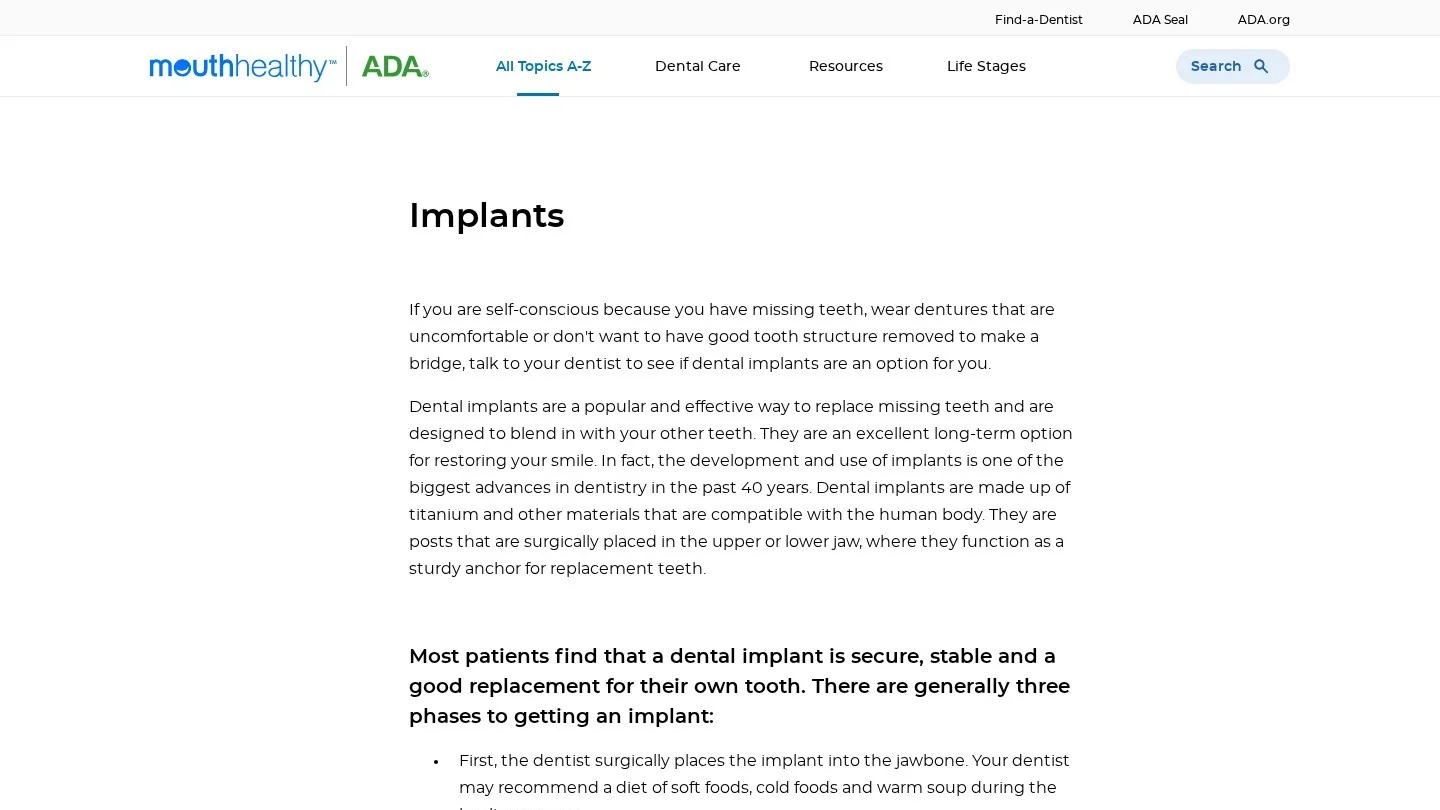
For bridges, the ADA calls a fixed bridge a fixed partial denture that “bridges” the gap left by missing teeth. It attaches to the surrounding teeth for support, and only a dentist can remove it. Bridges can be made of gold, alloys, porcelain or a mix. Because a bridge relies on its foundation, the ADA stresses keeping the remaining teeth healthy.
The ADA’s implant page also notes why some patients choose implants: they do not want healthy tooth structure removed to make a bridge. And its missing-teeth page explains why the decision matters at all. A gap can affect how you speak or eat, nearby teeth may shift, and bone loss can occur around a missing tooth.
Notice what the ADA pages do not give: lifespans in years or success rates. If you want those numbers on your page, your dentist should pick the source and stand behind it. Otherwise, leave them out.
Publish One URL per Treatment Pair, Never Forty Clones
The fastest way to ruin this tactic is volume. A practice publishes 40 versus pages in a month, each 400 words long with the same template. Then it copies each one for three city pages. In our view, that is the “made mainly to attract search visits” pattern Google warns against.
Use three rules to avoid it. First, one comparison gets one URL for the whole practice, as Gentle Dental does for 49 offices. Second, each page must add something only your practice knows, such as your own process, your timeline or your financing. Third, merge pairs that share most of their content. For example, “implant vs bridge” and “bridge vs implant cost” belong on one page.
Also, link each comparison page to both treatment pages, and link both back. Our guide to dental website ranking factors covers internal linking between treatments.
Cut Claims You Cannot Back Up
Read each draft line by line and mark every claim. Then ask one question of each: where does this come from? If the answer is “every site says it,” cut it or find a source your dentist accepts.
| Risky Wording | Safer Wording |
|---|---|
| “Implants last a lifetime.” | “With good care, implants can last many years. Your dentist will explain what affects that.” |
| “Painless implant surgery.” | “We use local anesthetic, and sedation is available. Ask us what to expect.” |
| “The best way to replace a tooth.” | “The right option depends on your bone, your nearby teeth and your goals.” |
| “Implants cost $X.” | “Typical fees at our office range from $X to $Y. Your quote follows an exam.” |
| “Guaranteed results.” | Remove it. |
Prices need the most care. KYT and Rockville both give ranges, and KYT labels its figures as typical for its own county. So if you publish fees, state that they are your office’s typical range and that an exam sets the final quote.
Check the Advertising Rules in Your Dental Practice Act
State dental laws on advertising can reach treatment pages too. California is a good example of how specific these rules get. Business and Professions Code section 1680 lists acts that count as unprofessional conduct for a licensed dentist.
- Subsection (h) covers advertising statements “tending to deceive or mislead the public.”
- Subsection (i) covers advertising that professional services are performed “in a superior manner,” with an exception for advertising allowed under section 651(h).
- Subsection (l) covers advertising “to guarantee any dental service, or to perform any dental operation painlessly.”
Those three map straight onto comparison pages. “Painless” sedation claims, “best implant dentist” lines and guaranteed outcomes can easily creep into a versus page. So for a California office, the safer wording in the table is the only wording. Other states have their own rules, so read your state’s dental practice act or ask your board before you publish.
Build Each Comparison Page in Seven Steps
We use the same order for every pair. It keeps the facts sourced and the dentist involved from the outset.
- Confirm the practice offers both treatments, or explains its referral path.
- Collect clinical facts from ADA pages and the dentist, with a note of each source.
- Draft a short answer at the top: which patients each option tends to help.
- Add one fair table with the same rows for both options.
- Add your office’s own fee range, timeline and financing, labeled as yours.
- Run the claims table and your state’s advertising rules over the draft.
- Have the dentist approve it, then publish with their name and a booking link.
For markup on these pages, our dental schema markup guide covers the types to use on treatment content.
Sort Out Common Doubts About Treatment Comparison Pages
Should a Comparison Page Recommend One Option?
It can say which patients each option tends to help. However, the final choice belongs to the exam. Rockville Dental Arts ends its page on that point.
Can We Use Cost Figures From Other Websites?
Use your own office’s typical range instead. Figures from other sites may not match your area or your fees, and patients will hold you to the figures you publish.
Does Each Office in a Group Need Its Own Comparison Page?
No. One page for the group works, as Gentle Dental shows across 49 offices. Link it from each office page.
Can AI Draft a Comparison Page?
AI can produce a first draft, but a dentist must check every clinical line. Google’s guidance also asks you to disclose how content was made where readers would wonder.
Publish Your First Comparison Page With a Dentist’s Sign-Off
Pick the pair your front desk explains most often. Build that one page in the seven steps, get the dentist’s name on it, and link it from both treatment pages. If you want help with the build, request quotes from dental SEO agencies or compare firms on Dental SEO Agencies.