The most useful lead generation tactics for a dental practice catch people who already need a dentist. That means a same-day emergency page, a way to book by text or a short form, and a review request after every visit. After that come self-pay offers, referrals and community work, which bring in patients who are not searching yet.
We researched 12 tactics and opened a real dental practice page for each one. So you can visit and copy every example. For each tactic, we give the steps, the example, a way to measure it and the rules to follow. Then we rank all 12 by cost, speed and effort.
Request Dental SEO Quote
Six Lessons From the 12 Practice Pages We Studied
- Emergency patients call first. One UK practice tells them plainly that calling is the fastest way to be seen today.
- The implant landing page we studied leads with the monthly payment and names its financing partners.
- A refundable deposit protects free consultation slots from no-shows.
- Membership plans give uninsured patients a yearly price they can compare.
- The FTC bans review rewards tied to a positive review, and it bans hiding bad reviews while implying you show them all.
- A vendor that handles protected health information for your forms or texts is a HIPAA business associate. You need a written contract with it.
Catch Patients at the Moment They Need Care
These three tactics answer people who are already looking. Someone with a broken tooth wants a time today. Someone pricing implants wants a number. And someone thinking about braces wants an answer without a visit.
Build an Emergency Page With a Call Button and Online Booking
An emergency page turns pain into a booked visit. So give it one job: get the patient into a chair today.
- Hold a few same-day slots open for new and existing patients.
- Put your phone number at the top, in the middle and in the footer.
- Add an online booking button next to the call button.
- List the urgent cases you see first, and state your emergency fee if you charge one.
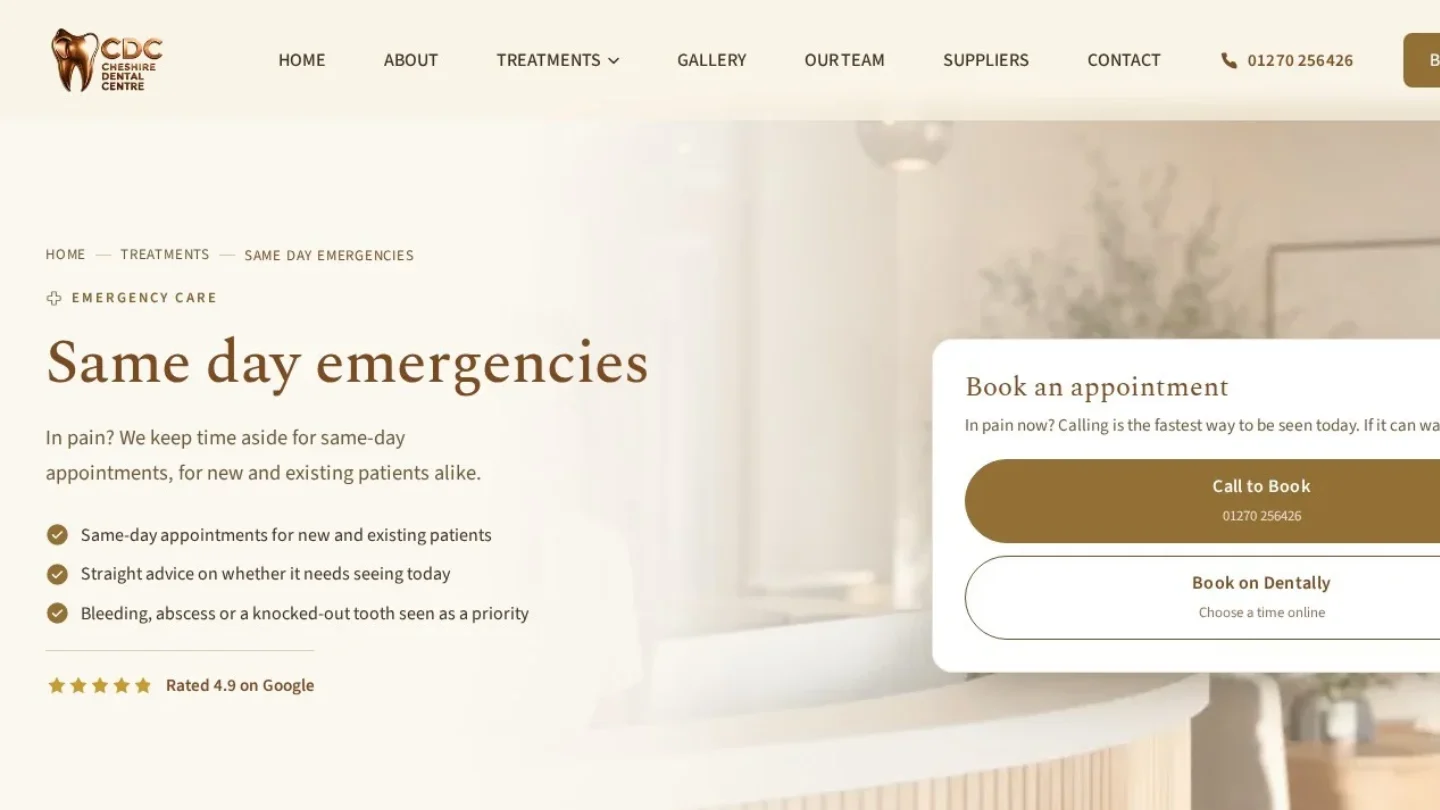
Cheshire Dental Centre in Crewe, England, does all four on its same-day emergencies page. It says, “Calling is the fastest way to be seen today. If it can wait, book online.” The page lists a £69 fee for an emergency visit seen that day, and it quotes any treatment before starting. Bleeding, abscesses and knocked-out teeth are seen as a priority. Also, the phone number appears four times.
Measure it: Give the page its own call tracking number, and mark the booking button as a GA4 key event. Then count emergency visits that came back for more treatment. Our guide to the Google local 3-pack for dental clinics covers the map side of urgent searches.
Give Each Implant Treatment a Landing Page That Leads With Payments
Implant shoppers want to know what it costs each month. So build a landing page for one treatment, and answer that question in the headline.
- Write a headline that names the treatment and the payment option.
- Name each financing partner and its terms.
- Repeat one call to action after every section.
- Put the offer’s fine print on the page.
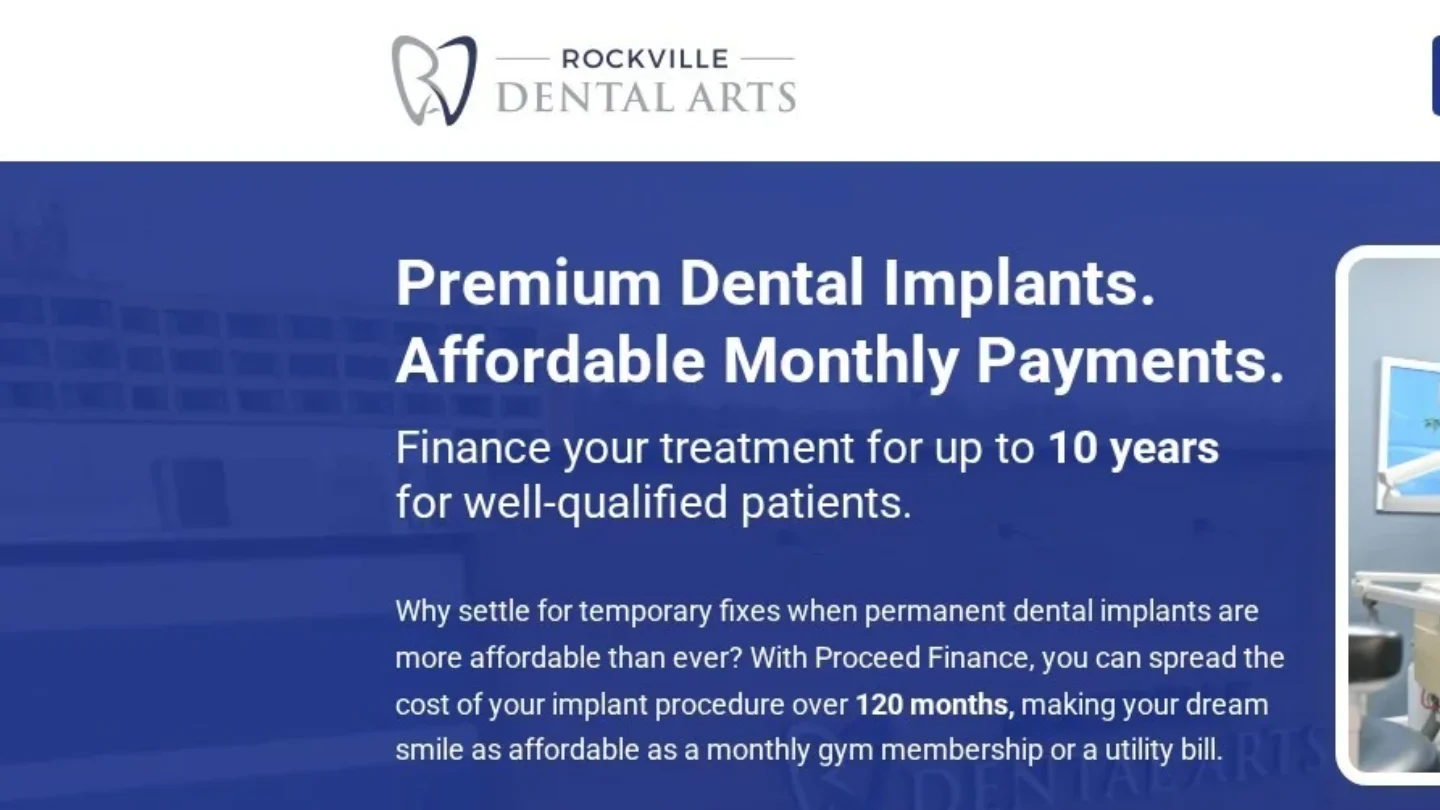
Rockville Dental Arts in Rockville, Maryland, runs an implant landing page with the headline “Premium Dental Implants. Affordable Monthly Payments.” It offers financing for up to 10 years to well-qualified patients and names CareCredit and LendingClub. New patients get a free implant consultation and a 3D scan. The fine print says the offer cannot be combined with insurance and is valid for 90 days. Every button on the page calls the office.
Measure it: Track calls from the page, then the share of callers who book a consult and accept a plan. If paid ads feed the page, our comparison of Google Ads and dental SEO shows how to weigh both channels.
Offer a Free Photo-Based Orthodontic Consult
Many adults and parents want a first opinion before they take time off for a visit. A photo consult gives them one from home.
- Make two short forms, one for a child and one for an adult.
- Show the exact photos you need, with a sample for each.
- Have the orthodontist review the photos and send first recommendations.
- Call or text the patient to book the in-person visit.
Dental Associates, a Wisconsin dental group, runs a free orthodontic virtual consult. Patients pick the minor or adult form and upload eight smartphone photos. Three show the face and five show the teeth. Then an orthodontist reviews them, and the team follows up by phone or text.
Rules: Photos and notes a patient sends you can include health information. Under HIPAA, a vendor that handles protected health information on your behalf is a business associate. So you need a written contract with your upload or form vendor before you go live.
Measure it: Count uploads, then in-person consults, then started cases.
Remove the Steps Between a Search and a Booked Chair
A lead is only worth something once it books. These two tactics cut the effort on the patient’s side, and they protect your schedule on yours.
Let New Patients Book by Text, Phone or a Six-Field Form
Some people will not call. So give them three ways in, and keep the form short.
- Publish a text number next to your phone number.
- Ask only for name, phone, email, new or existing patient, a preferred date and a note.
- Add a line asking people not to send health details through the form or by text.
- Show your evening and Saturday hours on the same page.
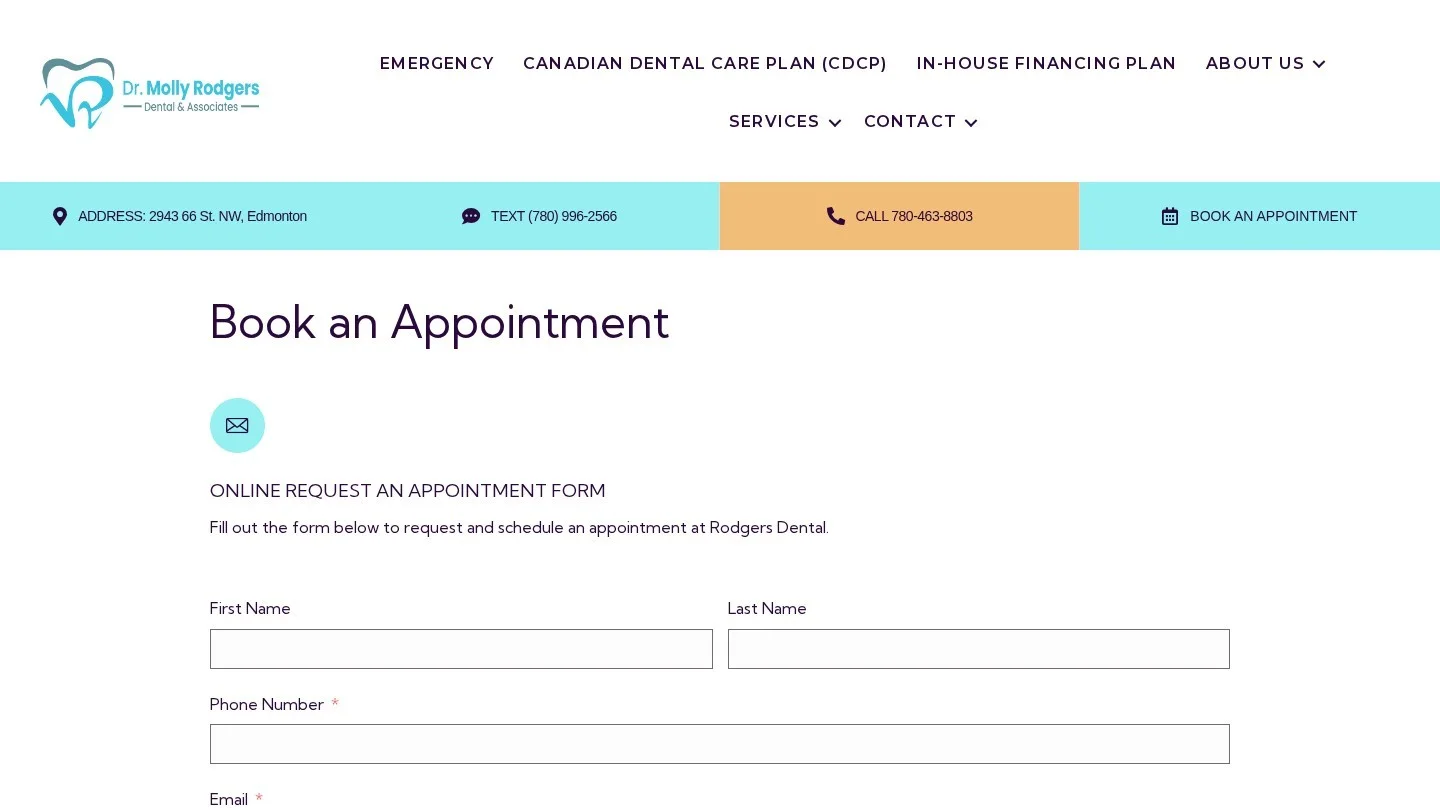
Rodgers Dental in Edmonton, Alberta, puts all three options on its book an appointment page. Patients can text, call or fill in a form. The form asks for first and last name, phone, email, whether they are new, a requested date and a message. The page also lists Thursday hours until 8 PM and Saturday hours. That gives working patients a reason to book here.
Rules: If your texting or form tool stores patient information, it is a business associate under HIPAA. So get the vendor’s business associate agreement in writing. A dental CRM often covers texting, and our dental CRM comparison lists what each one offers.
Measure it: Count form fills and texts each week. Then compare how many of each became a booked first visit.
Hold Free Consultation Slots With a Refundable Deposit
Free consults fill fast, and they also go empty fast. A small refundable deposit keeps the offer free for people who show up.
- Limit the free consult to new patients and to named treatments.
- Take a small deposit when they book, and apply it to treatment.
- Set a clear notice period for cancelling.
- Publish the policy on its own page.
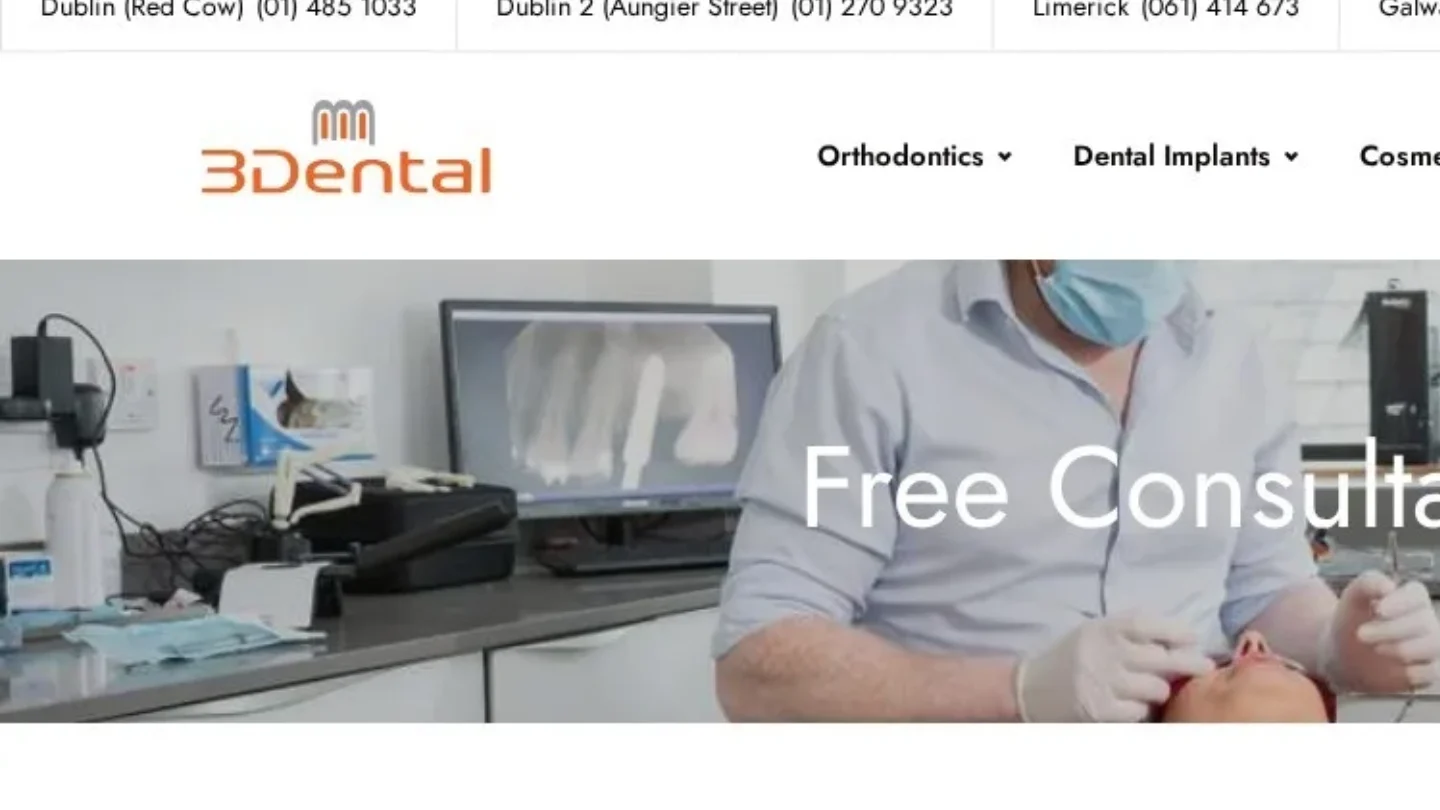
3Dental, with clinics in Dublin, Limerick and Galway, publishes a free consultation policy. New patients get a free first consult for implants, cosmetic work or orthodontics. A €50 deposit secures the slot, and it goes toward treatment. However, the deposit is lost if the patient misses, cancels or moves the visit with less than 48 hours’ notice. Implant patients can also get a 3D scan for €50 instead of the usual €150.
Measure it: Compare your consult no-show rate for three months before and after the deposit.

Give Self-Pay Patients a Clear Reason to Call
Patients without insurance often shop on price. So a published plan or offer gives them a figure to compare, and it gives your front desk a clear answer.
Sell an In-House Membership Plan to Uninsured Patients
A membership plan bundles a year of preventive care into one price. Many plans also add a discount on other treatment.
- List every visit, X-ray and screening the plan includes.
- Show a yearly price and a monthly price.
- Add a separate plan for gum disease patients who need more cleanings.
- State that the plan is not insurance.
Wahlen Dentistry in Perry, Utah, publishes its in-office membership plans with full prices. The VIP plan covers two exams, one emergency exam, two cleanings, routine X-rays and screenings. It also gives 20% off other treatment. The price is $549 a year, or $50 a month with a $59 setup fee. Two gum disease plans cost $649 and $759 a year. The page also lists no waiting period and no yearly maximum.
Measure it: Track sign-ups each month and how many members stay past one year. Also count treatment members accept at the 20% discount.
Publish a New-Patient Offer With Every Condition Spelled Out
A first-visit offer works when patients know exactly what they get. Hidden conditions cause angry calls and bad reviews.
- Name what the visit includes, such as exam, X-rays and cleaning.
- Say whether the offer works with insurance.
- State what happens when a patient needs more treatment.
- Put the booking form on the same page.
Gentle Dental, a group with offices in Massachusetts and New Hampshire, runs a new patient offer page that does this well. The offer covers an exam, X-rays, a cleaning and a treatment plan. The terms say it cannot be combined with insurance or other offers. Payment is due at the first visit, and the offer does not apply to emergency visits. Then a request form sits on the same page.

Measure it: Count offer bookings, then how many of those patients return for their next cleaning.
Turn Today’s Patients Into Next Month’s Leads
Your current patients reach new ones in two ways. They write reviews that strangers read, and they tell friends. Both have federal or board rules you need to follow.
Invite Every Patient to Review You on Google
Reviews decide many first bookings. So ask everyone, every time, in the same words.
- Add a “Leave a Google review” button to your reviews page.
- Send the same link to every patient after a visit.
- Invite all patients, whatever their visit was like.
- Read and answer the critical reviews too.
Omega Dental Specialists in Houston, Texas, follows this on its patient reviews page. It says, “Any patient is welcome to post a review on Google, whatever the experience was.” It also says, “We read every review, the favorable and the critical.” The page offers no reward and no filter.

Rules: The FTC’s rule on consumer reviews took effect on October 21, 2024. It bans incentives “conditioned expressly or by implication” on a review with a particular sentiment. It also bans implying that the reviews you show are most or all of your reviews when you held back bad ones. And it bans threats or intimidation to get a review removed. Our guide to getting more five-star dental reviews covers replies that protect patient privacy.
Measure it: Track new Google reviews each month and your average rating.
Reward Patient Referrals Within Your Dental Board’s Rules
A referral program gives patients a reason to mention you. So keep the reward small and the steps short.
- Check your state dental board’s rules on referral rewards first.
- Give the new patient a credit, and give the referrer a prize draw entry or a thank-you.
- Ask new patients to name the person who referred them when they book.
- Print the terms, such as age limits and what the credit cannot cover.
National Dental Care in Australia publishes a refer a friend page with clear terms. A referred friend gets a $30 credit, in Australian dollars, toward out-of-pocket costs. The referrer goes into a monthly draw for one of three $100 e-gift cards. Both people must be over 18. And the friend only has to give the referrer’s name at booking.

Measure it: Add “Who referred you?” to your new patient form. Then count referrals by month and by referring patient.
Meet Future Patients Away From the Dental Chair
These last three tactics are slower. Still, they reach families and workers before they ever search for a dentist.
Volunteer Your Team at a Give Kids a Smile Day
Give Kids a Smile is an American Dental Association program that gives children free dental care. Taking part puts your team in front of local parents.
- Ask your local dental society about Give Kids a Smile events near you.
- Ask dentists, hygienists and front-desk staff to volunteer.
- Write a post afterward with the numbers: children seen and care given.
- Share the post with schools and local news.
Park Dental, a Minnesota group, wrote up its 17th year of Give Kids a Smile. On February 7, 2020, nine Park Dental practices took part. Twelve doctors and 45 team members treated more than 115 children. They gave over $73,000 in free care. That care included cleanings, sealants, fillings and extractions.
Measure it: Track visits to the post, links from local sites and new family bookings in the following months. Our link building guide for dentists shows how to turn coverage into local links.
Host a Free Online Implant Seminar
Implant patients often wait months before they book. A seminar lets them learn first, with no pressure.
- Run the seminar online so people can join from home.
- Cover how implants work and who they help.
- Give attendees a consult and imaging with a clear expiry date.
- Keep a waiting list for the next date.
Dental Associates in Wisconsin promotes a free dental implant seminar. The page calls it a “free, no-obligation educational seminar” held online. Attendees get a one-on-one consultation and a free 3D CT scan of the jaw. Both must be used within 90 days. Seats are limited, and the page says more dates are coming.

Measure it: Count sign-ups, attendees, consults booked within 90 days and cases started. Our dental content marketing funnel covers the follow-up emails.
Set Up a Booking Page for a Large Local Employer
A big employer can send you hundreds of families. So give its staff a page of their own.
- Ask the HR team of a local employer, school district or city to share your page.
- List the visit types staff can book online.
- Let them pick the nearest office.
- Add a text line just for booking.
Dental Associates runs a City of Milwaukee appointment concierge page. City staff can book an adult cleaning, a new patient exam, a child’s exam and cleaning, or an orthodontic consult. First, they choose a clinic. They can also text a number that is only for booking.

Measure it: Use a separate booking link for each employer. Then count bookings by employer each quarter.
Rank the 12 Tactics by Cost, Speed and Effort
We scored each tactic from 1 to 3 on three things. Cost is 1 for staff time only, 2 for software, discounts or credits, and 3 for free care or imaging. Speed is 1 when leads can come within days, 2 for weeks and 3 for months. Effort is 1 for a one-time setup, 2 for steady weekly work and 3 for an event or campaign. Then we added the scores. A lower total is cheaper and faster to set up.
| Rank | Tactic | Cost | Speed | Effort | Total |
|---|---|---|---|---|---|
| 1 | Refundable deposit for free consults | 1 | 1 | 1 | 3 |
| 2 | Text, phone and a six-field form | 2 | 1 | 1 | 4 |
| 3 | New-patient offer with clear terms | 2 | 1 | 1 | 4 |
| 4 | Emergency page with call and booking buttons | 1 | 2 | 1 | 4 |
| 5 | Free photo-based orthodontic consult | 2 | 1 | 2 | 5 |
| 6 | Implant landing page that leads with payments | 2 | 2 | 2 | 6 |
| 7 | In-house membership plan | 2 | 2 | 2 | 6 |
| 8 | Patient referral rewards | 2 | 2 | 2 | 6 |
| 9 | Google reviews from every patient | 1 | 3 | 2 | 6 |
| 10 | Booking page for a local employer | 1 | 3 | 2 | 6 |
| 11 | Free online implant seminar | 3 | 2 | 3 | 8 |
| 12 | Give Kids a Smile volunteer day | 3 | 3 | 3 | 9 |
A low score does not mean low value, though. Reviews take months, yet they keep working for years. In the same way, a free care day costs the most, but it puts your team in front of local parents and reporters. So pick two quick tactics and one slow one, and run them together.
Track Which Tactic Booked Each New Patient
Every tactic above needs one number you can count. So set up tracking before you launch anything.
- Calls: Use a separate tracking number for each landing page and campaign.
- Forms and bookings: Mark each completed booking as a GA4 key event.
- Links you share: Add UTM tags to links in emails, posts and employer pages.
- The front desk: Ask every new patient how they found you, and record the answer in your practice software.
Then compare the cost of each tactic with the new patients it booked. Our guide to calculating dental SEO ROI walks through the same math for search. Keep patient names and treatment details out of analytics tools unless your vendor has signed a business associate agreement.

Check These Answers Before You Launch a Lead Campaign
What Is the Fastest Way to Get New Dental Patients?
An emergency page and a shorter booking path work fastest. In our scoring, a text line, a short form and a clear new-patient offer can bring bookings within days.
Can a Dental Office Give Patients a Reward for a Google Review?
Not a reward tied to a positive review. The FTC rule bans incentives conditioned, expressly or by implication, on a review with a particular sentiment. So the safest habit is to ask everyone and offer nothing.
Are Dental Referral Rewards Legal?
It depends on where you practice. Rules differ by state and country, so check with your dental board before you launch a program.
Do Online Booking Forms Need to Be HIPAA Compliant?
If a vendor stores patient information for you, it is a business associate under HIPAA. You then need a written contract with that vendor. Also, keep the form to contact details and a preferred time.
Should a Small Practice Hire an Agency for Lead Generation?
Many of these tactics need only staff time. Still, landing pages, ads and tracking take skill. If you want help, you can compare dental marketing agencies in the USA.
Roll Out Three Tactics in the Next 30 Days
In week one, add a text line and cut your booking form to six fields. In week two, rebuild your emergency page with a call button and online booking. Then, in weeks three and four, start sending a review link to every patient. After 30 days, check your tracking numbers and add the next tactic from the table.